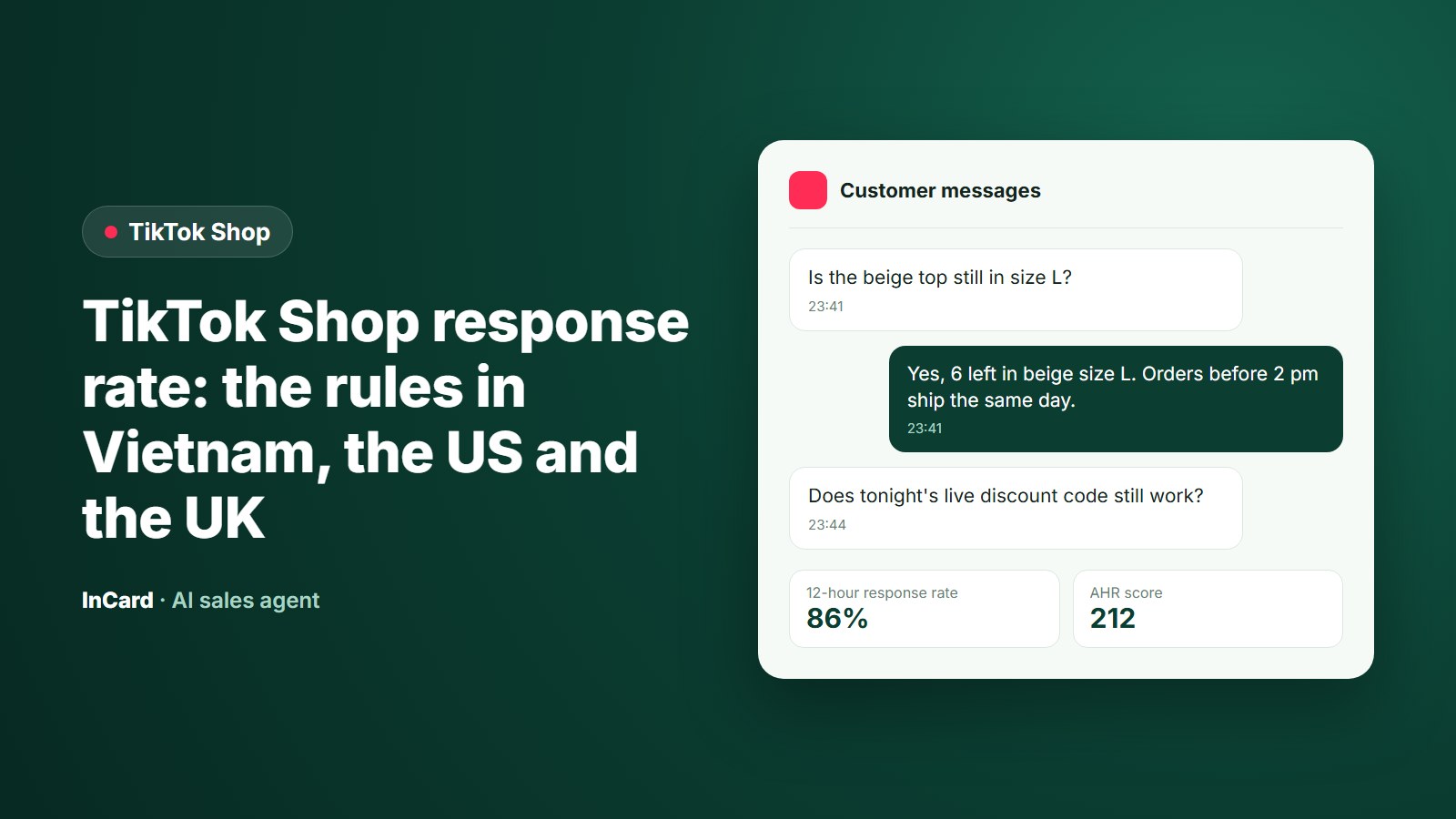
The TikTok Shop response rate is the share of buyer-started chats that a shop answers within a fixed window, and the window, the threshold and the penalty all depend on the market. In Vietnam the window is 12 hours over the last 30 days and the threshold is 85%, with Account Health Rating (AHR) points deducted below 75%. In the US the window is 24 hours over the previous 7 days and the threshold is 90%. In the UK it is 24 hours with a target above 90%, although since July 2026 it no longer feeds the UK Shop Performance Score. In every market, auto-replies and chatbot answers do not count as replies, which is why shops selling through livestreams, with many messages arriving after hours, slip most easily.
Key takeaways:
- Vietnam: answer within 12 hours and hold 85% or more. 75–84% earns a warning, 51–74% costs 10 AHR points, 50% or below costs 20 AHR points.
- US: answer within 24 hours and hold at least 90%, measured weekly over 7 days. UK: answer within 24 hours, above 90%.
- Chats resolved by auto-replies, FAQs or the chatbot are left out of the calculation, so they never raise the rate. Only Holiday Mode pauses the count.
- The Account Health Rating runs from 0 to 1,000 and every shop starts at 200. Falling below 150, 100 and 50 points brings growing restrictions; 0 can mean permanent closure.
- Sharing phone numbers, outside chat accounts or links, or asking for buyers’ personal details in chat is banned in every market and can cost AHR points or the account.
Response rate rules by market
The same metric name hides three different rules. The table below is drawn from TikTok Shop’s Seller University pages for each market, checked in November 2026. Rules change often, so confirm the current version in your own Seller Center.
| Market | Window and period | Threshold | Below the threshold |
|---|---|---|---|
| Vietnam | Reply within 12 hours; last 30 days; nights, weekends and holidays count | 85% or more (from July 2026) | 75–84%: warning. 51–74%: minus 10 AHR points. 50% or below: minus 20 AHR points |
| United States | Reply within 24 hours; previous 7 days, reviewed weekly. With the Chatbot on, weekend messages must be answered by Monday 12 pm local time | At least 90% | May result in violations: AHR deductions, message blocking, listing removal, chat restrictions, shop deactivation. Point values are not published |
| United Kingdom | Reply within 24 hours; not measured below 5 messages in 7 days | Above 90% | Enforcement under the UK Seller Performance Evaluation Policy. Since 22 July 2026 the Shop Performance Score uses IM Dissatisfaction Rate (1–2 star chat ratings) instead |
The rest of this guide works through the Vietnam rules in detail, because they are the strictest window and the only market with published penalty tiers. The process in the second half applies in every market; only the window changes.
How the 12-hour rate is calculated in Vietnam
According to the customer service communication requirements on TikTok Shop Vietnam’s Seller University, the metric takes every buyer-started chat in the last 30 days and counts how many the shop answered within 12 hours. Penalties only apply when the shop has more than 2 chats in those 30 days, and the current figure is shown in Seller Center under Shop Health.
| Counted | Not counted |
|---|---|
| Buyer-started chats, including at night, at weekends, on holidays and outside the shop’s own working hours | Chats received while the shop is in Holiday Mode |
| A carrier contact card, when the buyer is passed to the delivery company, counts as a reply | Chats the shop starts itself, including bulk messages |
| Real replies sent from the shop account within 12 hours, whether by the owner or by staff given the account | Chats resolved by auto-reply or FAQ; chats from blocked buyers |
The calculation is simple to do by hand. A shop receives 400 buyer-started chats in 30 days and answers 330 within 12 hours: 330 divided by 400 is 82.5%. The shop is in the warning zone and needs at least 10 more timely replies on the same volume to reach 85%.
The line people most often misread is “auto-reply or FAQ”. A chat resolved by TikTok Shop’s automatic assistant is removed from the calculation entirely: it is not counted as a miss, but it is not counted as a reply either. A shop cannot use automated messages to lift its rate. When the automated message does not solve the chat and the buyer asks again, a person still has to answer within 12 hours. The US and UK pages say the same: automated responses and chatbot conversations that never reach a person are excluded.
The Vietnam page also shows two reference metrics, average response time and chat satisfaction rate. These carry no penalty and no threshold for now. TikTok Shop does note that shops replying within 2 hours see 33% higher buyer satisfaction.
Penalty tiers and the Account Health Rating
| 12-hour response rate (Vietnam) | Consequence |
|---|---|
| 85% or more | Meets the requirement |
| 75 to 84% | Warning |
| 51 to 74% | Minus 10 AHR points |
| 50% or below | Minus 20 AHR points |
In Vietnam, the AHR is a 0 to 1,000 scale calculated over 90 days. It replaced the old violation points system for all sellers from 1 July 2026. New shops start at 200 points, gain 4 points for every 200 completed orders (up to 16 points a week) and 5 points for passing a policy quiz. Deducted points come back after 90 days, or sooner after a successful appeal.
The thresholds decide what the shop is allowed to do:
- Below 150 points: 7 days without campaign participation or free shipping support.
- Below 100 points: 14 days of those restrictions, plus no new or edited listings and reduced livestream traffic.
- Below 50 points: the shop is closed for 28 days.
- At 0 points: the shop is closed permanently.
The US runs a similar scale with different details: 0 to 1,000 over the last 180 days, starting at 200, with restrictions at 150, 100 and 50 points (the last also freezes withdrawals for 30 days) and possible permanent deactivation at 0. US shops recover 4 points per 200 completed orders, up to 20 a week, and points reset after 180 days.
A new Vietnam shop at 200 points only needs two months in a row below 50% to lose 40 points and fall into the zone where it cannot join campaigns. For a shop that lives on flash sales and livestreams, that is lost revenue, not just a number in Seller Center. If the shop is also losing points for other reasons, such as late shipping, chat is the easiest part to control so the deductions do not stack.
Why livestream sellers miss the threshold most
A livestream pulls a large audience into the shop in a short time, usually in the evening. Viewers ask about sizes, discount codes and shipping fees while the seller is busy on air. After the stream, the remaining messages pile into the inbox just as the team is tired and off shift. TikTok Shop has not published figures on message volume after livestreams, but it is a pattern almost every live-selling shop meets.
Three things make this group slip fast:
- Messages outside working hours still count. The stream ends at 11 pm, a buyer writes at 11:30 pm, and a reply at 11:30 am the next day is already past 12 hours.
- Automated messages do not save the rate. Chats answered automatically are excluded, and a specific question like “is the beige top still in size L” is usually beyond an automated reply.
- The person covering chat is also presenting the stream or packing orders. When one person does three jobs, chat is always the one left for later.
A shop can use Holiday Mode on days it genuinely stops selling, but it cannot switch it on every night. The practical answer is to have a person, or a layer that sends real replies, covering the night.
What you must not say in TikTok Shop chat
This is where many shops break the rules without meaning to, especially those used to selling through Facebook, WhatsApp or Zalo. The communication requirements in Vietnam, the US and the UK all say that in chat with buyers, a shop must not:
- Share phone numbers, email addresses, social media accounts, other messaging accounts or outside links to take buyers off the platform.
- Ask for buyers’ personal information.
- Send bank account details, payment QR codes, offers to refund or return outside the platform, or ask buyers to cancel orders.
- Spam, harass, offer gifts for reviews, or give false information about promotions, products, prices or stock.
In Vietnam, inappropriate or prohibited communication can cost up to 50 AHR points, and taking buyers off the platform can lead to suspension or permanent closure. The UK rules also ban unauthorised plug-ins and third-party tools that tamper with the chat feature. Anyone or anything that answers chat for the shop, AI included, must be set up so it never sends any of the above.
TikTok Shop’s own automation tools
In Seller Center, TikTok Shop’s chat assistant groups several tools: an automatic greeting with frequently asked questions, saved replies, reply recommendations that suggest answers to staff, a Chatbot that answers when staff are offline or busy, and automatic updates on shipping, delivery and late orders. The FAQ library has to be set up before the chatbot can work.
In Vietnam, from July 2026, when a shop’s Chatbot is on, buyers may be passed to the carrier or TikTok Shop’s own customer service. TikTok Shop Vietnam also says that if a shop’s non-response rate is significantly high, the platform may switch on the customer service chat assistant for the shop, reviewed every 30 days.
Shops should switch these tools on so buyers always get a first response. But remember the limit described above: chats resolved automatically are excluded from the calculation, so these tools reduce the workload without replacing real replies to specific questions.
A process to stay above the threshold
Step 1: Measure your starting point. What to do: open Shop Health, note the response rate and current AHR; export 30 days of chats and mark the ones answered late by the hour the buyer wrote. Expected result: you know which hours the shop misses, usually after livestreams and in the early morning. Common mistake: looking only at the overall number without knowing when the misses happen.
Step 2: Switch on the platform’s automation. What to do: turn on the automatic greeting with FAQs and automatic order updates, and write FAQs from the 10 questions buyers ask most. Expected result: simple order questions are handled without a person. Common mistake: vague FAQs that send buyers back to ask a person anyway.
Step 3: Staff the risky hours. What to do: assign one person to cover chat during and after each livestream, not someone who is also presenting or packing; set an internal target of 2 hours instead of the platform’s window. Expected result: a safety margin, so a slightly late reply still lands inside the platform’s window. Common mistake: using the platform’s 12 or 24 hours as the internal target, so one busy night is enough to miss.
Step 4: Prepare compliant replies. What to do: write replies for price, stock, sizing, shipping and returns questions, with a banned list: no phone numbers, no outside chat accounts, no outside links. Expected result: whoever is on duty answers consistently and does not break the rules by accident. Common mistake: staff out of habit asking for the buyer’s number “so we can advise you”, as they would on Facebook.
Step 5: Review weekly. What to do: check the response rate and AHR every Monday against the previous week’s livestream and sale calendar. Expected result: you see the rate falling before it reaches the warning zone. Common mistake: only checking after a warning, when the bad data is already sitting in the calculation period.
Where an AI agent fits in this process
Step 3 is the most labour-intensive: someone has to cover the post-livestream hours and the night. This is where an AI agent replying inside the shop’s own account helps. With InCard, the owner logs in to the TikTok Shop account once through a remote browser session; the session is encrypted and the shop keeps full control to switch it off at any time. The AI reads the question, checks it against the prices, stock and policies the shop has loaded, and sends the answer as a normal message from the shop account. Unlike automated messages that are excluded from the calculation, these are real replies to the buyer’s specific question. InCard runs this on TikTok Shop in Vietnam today.
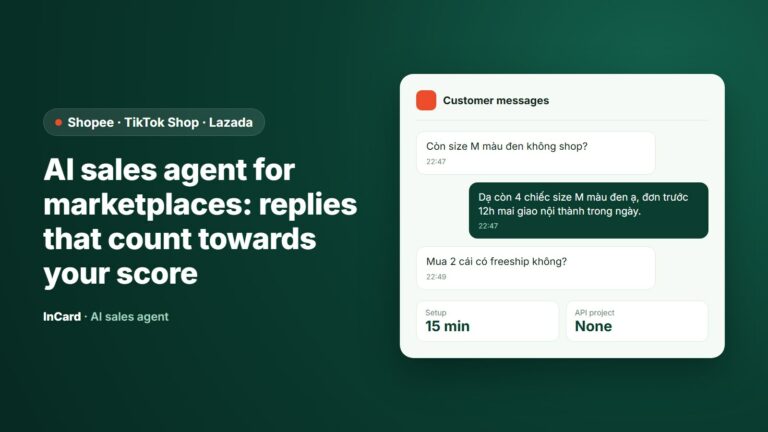
On TikTok Shop, the AI is configured around the banned list above: no phone numbers, outside chat accounts or links, no requests for buyers’ personal details, and hand-over to a person for complaints, refund requests and suspicious orders. For shops and agencies running livestreams, InCard can also run in read-only mode, turning hundreds of post-stream messages into a sales report, so the team knows what buyers asked most and which products drew interest. The full operating model is on the AI sales agent page, and AI sales agent for Shopee, TikTok Shop and Lazada compares how the marketplaces score chat.
The boundary needs saying: the AI does not decide refunds, settle disputes or negotiate wholesale prices for the shop, and it only answers correctly within the data it has been given. A shop whose price and stock data is in a mess should clean it up before switching on any automation.
Frequently asked questions
Do automatic messages raise the TikTok Shop response rate?
No. Chats resolved by auto-reply, FAQ or the chatbot are removed from the calculation, so they do not raise the rate. Automated messages give buyers a first response; specific questions still need a real reply within the window.
Is the TikTok Shop response window 12 or 24 hours?
It depends on the market. TikTok Shop Vietnam uses 12 hours over 30 days. TikTok Shop US and UK use 24 hours. Check the Seller University page for the market your shop is registered in.
Do messages at night and at weekends count?
In Vietnam, yes: messages at night, at weekends, on holidays and outside the shop’s own working hours all count. Only chats received in Holiday Mode are excluded. In the US, with the Chatbot switched on, weekend messages must be answered by Monday 12 pm local time.
How long until AHR points lost for slow chat come back?
In Vietnam, deducted points come back after 90 days, or sooner after a successful appeal; in the US, points reset after 180 days. Meanwhile the shop can still earn points through completed orders and policy quizzes.
Can I ask buyers for their phone number in chat to follow up?
No. Asking for buyers’ personal details and sharing phone numbers, other chat accounts or outside links are banned in TikTok Shop chat. In Vietnam the penalty can reach 50 AHR points, and taking buyers off the platform can lead to account closure.
Does TikTok Shop count AI replies as responses?
Messages sent by InCard’s AI agent are normal messages from the shop’s account, not messages from the platform’s automated tools, so they are recorded the same way as replies from staff. After switching on, track the rate weekly in Shop Health to verify it on your own account.
Start with the hours you are missing
Before adding people or tools, do step 1: find out which hours your late replies fall into. If they are mostly after livestreams and in the early morning, that is where a layer of real replies helps most. InCard builds the demo on the shop’s own data, including its price list, stock and past buyer questions, so the owner can read the answers and judge them before deciding. See the AI sales agent page or book a demo.
Tam Ho is the Founder of InCard, the agentic AI platform for small and mid-sized businesses in Vietnam. He works directly with operations teams to bring each chain of work onto the system, with a human keeping the checkpoint on the decisions that matter.