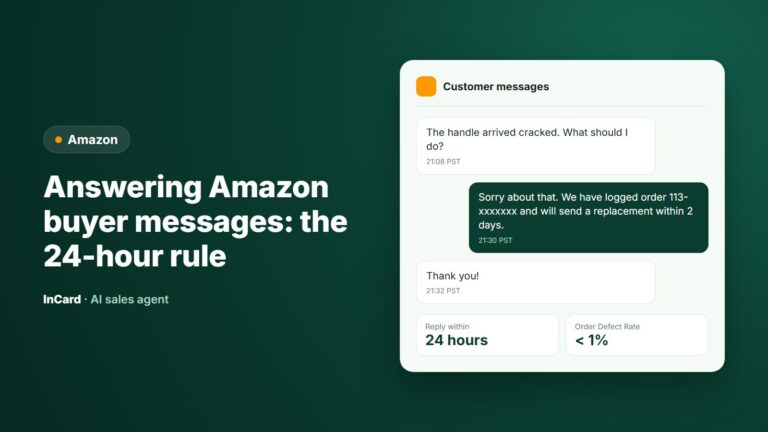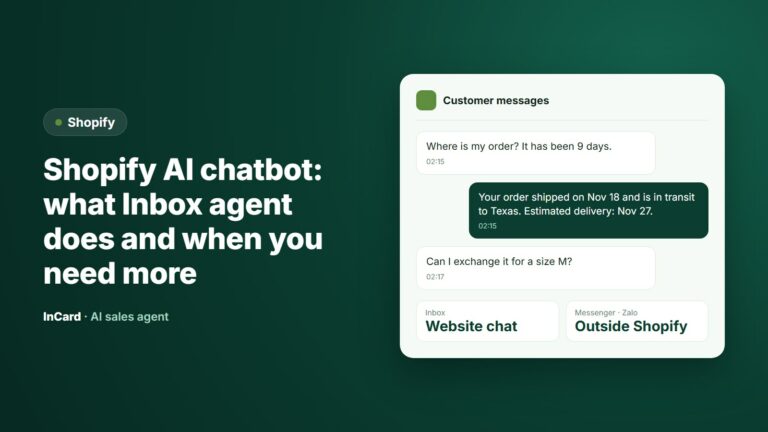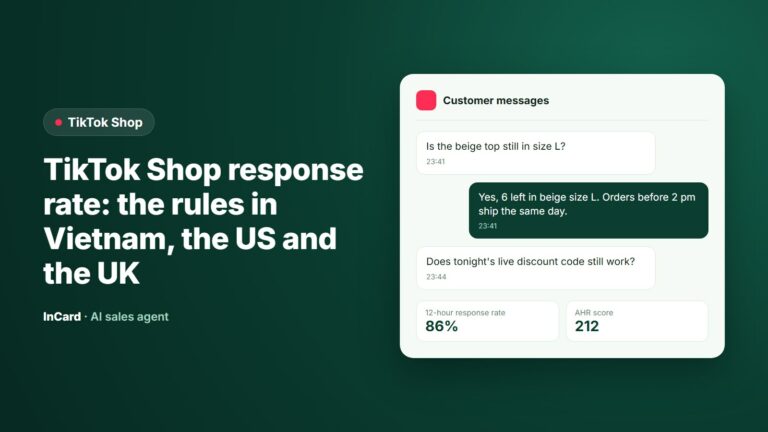
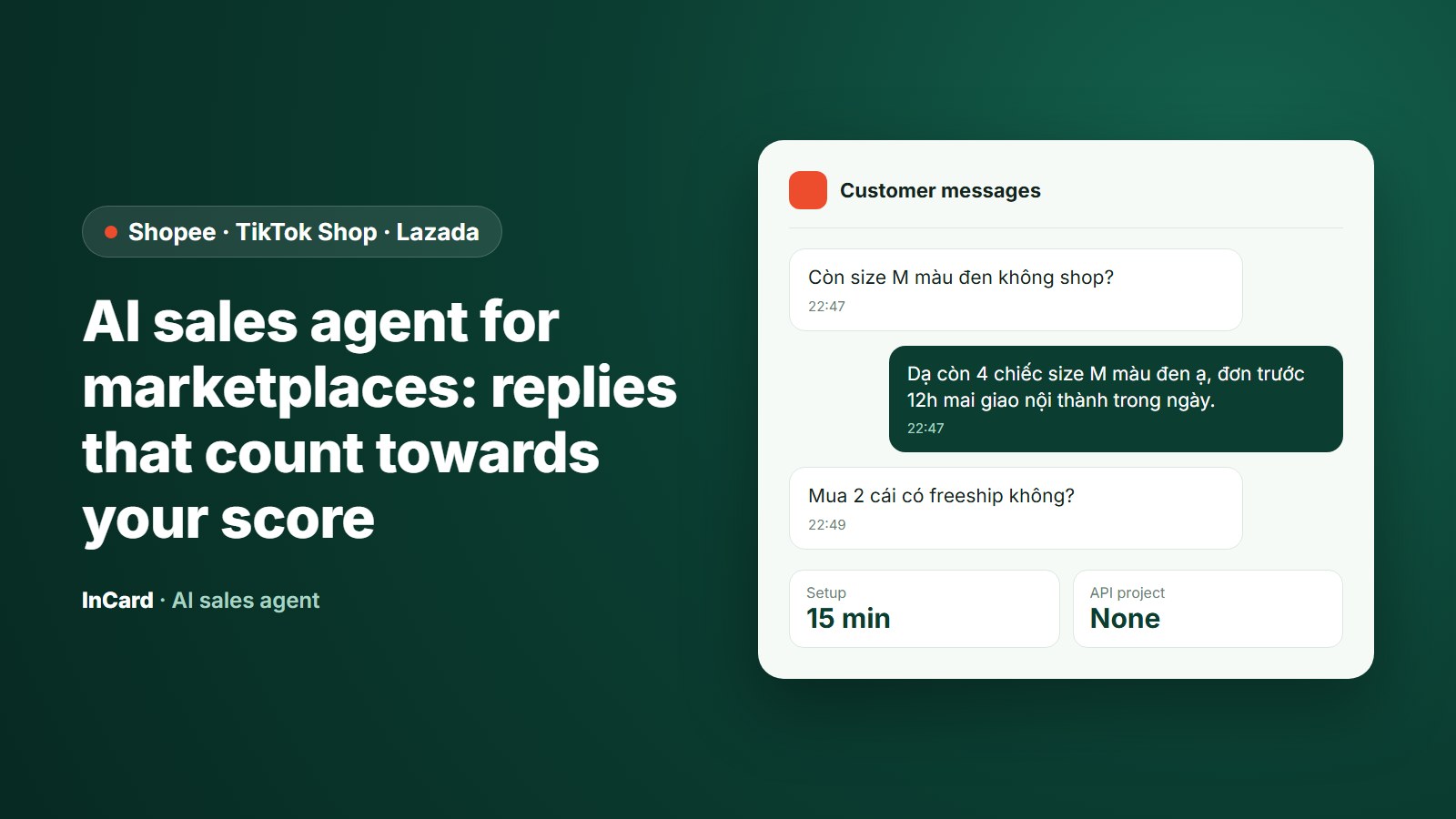
An AI sales agent for marketplaces is an AI assistant that works inside a shop’s own Shopee, TikTok Shop or Lazada seller account. The owner logs in to the marketplace account once through a remote browser session, the AI reads the prices, stock and policies the shop has loaded, and it answers buyer messages from inside that account, the same way a staff member assigned to the chat would. There is no API integration project and no partner approval to wait for, and the login takes around 15 minutes. The difference that matters most in Vietnam: messages sent by the AI are real replies from the shop’s account, so the marketplace counts them towards the chat response rate, while the marketplace’s own built-in auto-replies are not counted.
Key takeaways:
- All three marketplaces score shops on how quickly and how consistently they answer chat. Slow replies cost penalty points, preferred-seller badges and search visibility.
- Shopee’s built-in auto-reply does not count towards the Chat Response Rate (CRR). To protect the metric, the shop needs real replies sent from its account.
- InCard’s AI agent replies inside the shop’s own marketplace account, so its replies are counted the same way as a staff member’s.
- Setup is one login per marketplace account plus loading prices, stock and policies. There is no coding and no integration approval.
- The AI handles speed and repeat questions. Situations that need judgement, such as serious complaints or wholesale price negotiation, are handed to a person.
Why chat is where marketplace shops lose orders and points
Buyers on Shopee, TikTok Shop and Lazada message a shop at the exact moment they are deciding: is size M still in stock, when does the sale price end, how much is shipping to my province, how do returns work. If that message waits a few hours, the buyer has usually asked another shop the same evening. That is the lost order you can see.
The loss fewer shops notice is the score. Marketplaces in Vietnam measure how a shop handles chat with named metrics and published thresholds. Shopee uses the Chat Response Rate and first response time. TikTok Shop uses the 12-hour response rate and the Account Health Rating. When a metric drops below its threshold, the shop is warned, loses points, loses eligibility for badges such as Shopee’s Preferred Seller, and in more serious cases sees its products pushed down in marketplace search.
So the owner has two problems at once. One is revenue: answer fast so buyers do not leave. The other is compliance: answer consistently, including messages that arrive at midnight or in the middle of a packing rush, so the marketplace metrics do not slip. Hiring people to staff chat around the clock covers both, but it is expensive and hard to recruit for a small shop. That is where an AI sales agent comes in, and it is why this guide starts with how the marketplaces score chat before it explains how the AI works.
How the three marketplaces score chat response in Vietnam
Each marketplace measures it differently, but the logic is the same: a message must get a real reply, and the reply must land inside a fixed window.
| Marketplace | Metric | Threshold to hold | What happens below it |
|---|---|---|---|
| Shopee | Chat Response Rate (CRR): share of chats answered within 12 hours | Preferred Seller needs a CRR of 80% or more and a first reply within 4 hours; Preferred Seller Plus needs 90% or more and a first reply within 2 hours | Once penalty points reach 3, products are barred from promotions and lose search visibility |
| TikTok Shop | 12-hour response rate | 85% or more (threshold in force from 6 July 2026) | 75–84%: warning. 51–74%: minus 10 Account Health Rating (AHR) points. 50% or below: minus 20 AHR points |
| Lazada | Chat response metric in Seller Center | Check the current threshold in your own Seller Center | Affects the store’s performance assessment |
Two notes on this table. First, Lazada has no figure because our source check did not find a Lazada threshold firm enough to quote; open Seller Center and read your own store’s metric rather than trusting a number in any article. Second, both Shopee and TikTok Shop only count replies sent within the marketplace’s window. A message that arrives at 11 pm and gets answered the next morning is, to the buyer, “the shop replied”; to the marketplace metric, it is a missed chat.
These figures are for the Vietnam marketplaces. Thresholds and penalties differ by country, so a shop selling in other markets should check each market’s seller centre separately. The full calculation and penalty tiers for TikTok Shop are in our guide to the TikTok Shop response rate.
How an AI sales agent works on a marketplace
InCard’s approach differs from a normal software integration. Instead of building an API connection between the shop’s systems and the marketplace, the AI agent works inside the shop’s own marketplace account through a remote browser session, the same way a staff member is given the account to cover chat. The session is encrypted, the shop keeps full control of the account, and it can switch off access at any time.
Once logged in, the AI works from three layers of data that the shop loads into one place:
- Product data: list price, sale price and when it ends, stock by variant, size and colour, and substitutes when an item is out of stock.
- Shop policies: shipping fees and the free-shipping threshold, return conditions, warranty, delivery times by region.
- How the shop talks: forms of address, tone, the commitments it may make and the ones it must never make on the shop’s behalf, such as promising an exact delivery date before stock has been checked.
When a new message arrives, the AI reads the question, checks it against these three layers, then writes and sends the answer inside the marketplace chat. The buyer sees an ordinary conversation with the shop. When something falls outside the data or needs judgement, the AI stops and hands the chat to a person with a summary of what the buyer needs, rather than guessing.
How the full AI sales team runs, including chat channels outside the marketplaces such as Messenger and Zalo, is described on the AI sales agent page. This guide covers the marketplace side only.
The core difference: built-in auto-replies do not earn points
Many shops assume that switching on Shopee’s auto-reply takes care of response time. In practice, according to Shopee’s guidance as summarised by seller education sources, the platform’s built-in auto-reply does not count towards the Chat Response Rate. CRR only records real replies from the account. Auto-reply gives the buyer an instant greeting, but the shop’s metric still falls if nobody follows up.
It helps to separate three kinds of message in a shop’s account:
- Marketplace auto-replies: the greeting or template the platform sends when a buyer first writes. The buyer gets a message; the metric does not count it.
- Templates sent by hand: a staff member picks a saved reply and presses send. Counted, but only if someone is there when the message arrives.
- Replies sent by an AI agent inside the account: the AI reads the question, writes an answer from the shop’s real data and sends it as a normal message. Counted, because it is a real reply from the account, and it does not depend on who is on shift.
In other words, the question is not “does the buyer get some response” but “does the buyer get a real, correct reply within the marketplace’s window”. That second question is the one an AI agent answers.
Getting it running in 15 minutes
Login and activation take five steps. The 15 minutes covers logging in and switching on the AI; the care taken over loading data in step 2 decides whether the AI answers correctly from then on.
Step 1: Log in to the shop’s marketplace account. What to do: the owner logs in to their Shopee, TikTok Shop or Lazada account in InCard’s remote browser session, one login for each marketplace they sell on. Expected result: the AI can see the shop’s chat inbox and starts reading new messages. Common mistake: passing the login through several staff members; the account owner should log in personally and keep control of the session.
Step 2: Load prices, stock and policies into one place. What to do: enter the current price list with list price, sale price and sale end date; stock for each variant, size and colour; shipping, returns and warranty policies. Expected result: questions such as “is size M available” or “how much is shipping for two” are all answered from this single source. Common mistake: keeping one price on the marketplace and another in the seller’s head; the AI learns from what it is given, so wrong data produces systematically wrong answers.
Step 3: Set the handover rules. What to do: list the situations where the AI must stop and call a person, for example a defect complaint with photos, a wholesale price request, a refund outside policy, or an order that looks suspicious. Expected result: the AI handles the repetitive work and people only receive the chats that need them. Common mistake: skipping this step, so the AI either overreaches or hands over so often that the shop is back to staffing chat as before.
Step 4: Test with real questions from past buyers. What to do: take 15 to 20 questions word for word from the shop’s old chats, let the AI answer them and read every reply. Expected result: you catch misunderstandings about products or tone before buyers do, and fix them in the data and instructions rather than reply by reply. Common mistake: testing with easy questions you made up, then watching the AI struggle when real buyers phrase things differently.
Step 5: Go live and watch the marketplace metrics. What to do: switch the AI on for each marketplace, read a random sample of chats every day in the first week, and check CRR in Seller Center weekly. Expected result: the response rate holds steady through nights and packing peaks. Common mistake: switching it on and walking away, so a wrong answer is repeated many times before anyone notices.
What the AI can answer, and where the line is
In day-to-day trading, most marketplace messages fall into a handful of repeat groups: current price and offers, stock by size and colour, shipping cost and delivery time, how returns work, and order status. This is where the AI is strongest, because the answers are all in the data the shop has loaded, and replies take seconds instead of waiting for a shift.
The line needs to be stated plainly:
The AI does not make decisions that need judgement and carry responsibility: approving refunds outside policy, settling disputed complaints, committing to compensation, negotiating wholesale contracts. These go to a person, with a summary so they do not have to read the whole thread. A shop that expects the AI to handle these as well is not ready for it, because the risk sits in the decision, not in the wording.
The second line is data. The AI only answers correctly within the data the shop provides. A new product listed without its price and stock loaded gives the AI nothing correct to say; updating data when products are added is the shop’s job, and it should become as routine as updating stock.
Who it suits, and who should wait
An AI sales agent on marketplaces suits shops with three signs: daily message volume is beyond what the current team can answer consistently; CRR or the 12-hour response rate is near or below the marketplace threshold; and many messages arrive in the evening, at weekends or during sales, exactly when nobody is on shift. Shops selling on several marketplaces at once benefit most, because one AI team keeps every account answered at the same time instead of staff switching between apps.
Three kinds of shop should wait. First, a brand-new shop with so few messages that the owner answers them all the same day and the metrics are already high; its problem is traffic and product, not chat. Second, a shop whose prices and stock are in a mess, with a different number in every place; clean the data first, because the AI will turn that mess into wrong answers sent to buyers. Third, a shop that wants the AI to decide refunds and complaints on its own; that expectation goes past the safe line described above.
Measure before you decide
Before considering any solution, take three numbers from your own account. Together they show where the shop is losing, and how much.
- In Shopee Seller Center, note the current CRR and average first response time. Record them weekly to see the trend, rather than looking once and forgetting.
- Count how many chats in the last 30 days were answered after the 12-hour window, and how many were never answered. These are what pull the metric down, and they are also where buyers leave most often.
- Count the messages that arrive between 9 pm and 7 am. Nobody is on shift then, yet it is a busy time for online shopping; if a large share of messages arrive at night and few are answered in time, that is the clearest sign the shop needs a reply layer that the marketplace counts.
If all three numbers are healthy, the shop does not need another tool yet. If one is weak, that is where to start, whether the fix is people or AI.
Frequently asked questions
Does an AI sales agent need an API integration with the marketplace?
No integration project is needed. The AI works inside the shop’s own marketplace account through a remote browser session. The shop logs in once, loads its data and sets the handover rules, and the agent can start.
Shopee has an API, so why not connect through it?
Shopee does have a Chat API, but it closed registration for third-party customer service applications on 18 November 2024, so an individual shop has almost no way to connect chat through the API itself. TikTok Shop also grants messaging access through approved partners. Logging in to the account through a remote browser sidesteps this approval problem: the AI works in the shop’s account like a staff member who has been given the login, with no integration to approve.
Do the AI’s replies count towards Shopee’s Chat Response Rate?
Yes. CRR records real replies from the shop’s account, and the AI’s messages are normal messages from that account. What is not counted is the marketplace’s built-in auto-reply. That is the core difference between switching on auto-reply and having an AI agent that actually answers.
Can the AI quote the wrong price or stock level?
The AI answers from the data the shop loads. If prices and stock are correct and updated when they change, the answers follow that data. When a question falls outside the loaded data, the AI hands it to a person rather than guessing. Loading and updating data is the discipline the shop has to keep, just like keeping prices right on the product page.
How does a shop selling on Shopee, TikTok Shop and Lazada set this up?
Each marketplace is one login to the matching account, all sharing one layer of price, stock and policy data. Once switched on, the AI keeps all three accounts answered at once, and chats that need a person from any marketplace are collected in one place for the shop to handle.
How long does it take to get running?
Login and activation take about 15 minutes per marketplace account. The rest of the time goes into loading data and testing with real questions from past buyers; a shop with a clear price list and policies usually finishes in one working session.
More answers on how InCard works, account security and cost are on the FAQs page.
Start from your own shop’s data
The surest way to know whether an AI agent fits your store is not a feature tour but watching the AI answer your own data: your real price list, your real stock and questions your buyers have actually asked. InCard builds the demo that way, so the owner can read the answers and judge them before deciding. See how the AI sales team runs on the AI sales agent page, or book a demo built on your own shop’s data.
Fast replies are necessary but not sufficient; the other half is not letting buyers who asked to buy fall out of the process after a sale ends. Lead nurturing automation covers the follow-up once a campaign is over, and the 10 scripts for an AI sales assistant show how answers should change at each stage of the sale.
Tam Ho is the Founder of InCard, the agentic AI platform for small and mid-sized businesses in Vietnam. He works directly with operations teams to bring each chain of work onto the system, with a human keeping the checkpoint on the decisions that matter.