An AI chatbot for website interactions has become a critical tool for businesses looking to improve customer engagement, automate support, and increase conversions. By using artificial intelligence and natural language processing (NLP), website chatbots can understand user intent, respond instantly, and deliver personalized experiences at scale.
As customer expectations for real-time support grow, AI-powered website chatbots help businesses stay competitive without increasing operational costs.
What Is an AI Chatbot for Website Use?
An AI chatbot for website use is a software application powered by artificial intelligence that interacts with visitors through conversational interfaces. These chatbots can:
Answer frequently asked questions
Guide users through products or services
Capture and qualify leads
Provide customer support 24/7
Integrate with CRM and marketing systems
Unlike rule-based chatbots, AI chatbots learn from conversations and improve responses over time.
Key Technologies Behind AI Website Chatbots
AI chatbots for websites typically rely on several core technologies:
1. Natural Language Processing (NLP)
NLP enables the chatbot to understand user queries, context, and intent, even when questions are phrased differently.
2. Machine Learning Models
Machine learning allows chatbots to adapt responses based on user behavior and historical interactions.
3. Conversational AI Engines
These engines manage dialogue flow, maintain context, and deliver human-like responses across multiple interactions.
4. Website and CRM Integrations
AI chatbots integrate with websites, CRMs, help desks, and analytics tools to provide consistent and contextual responses.
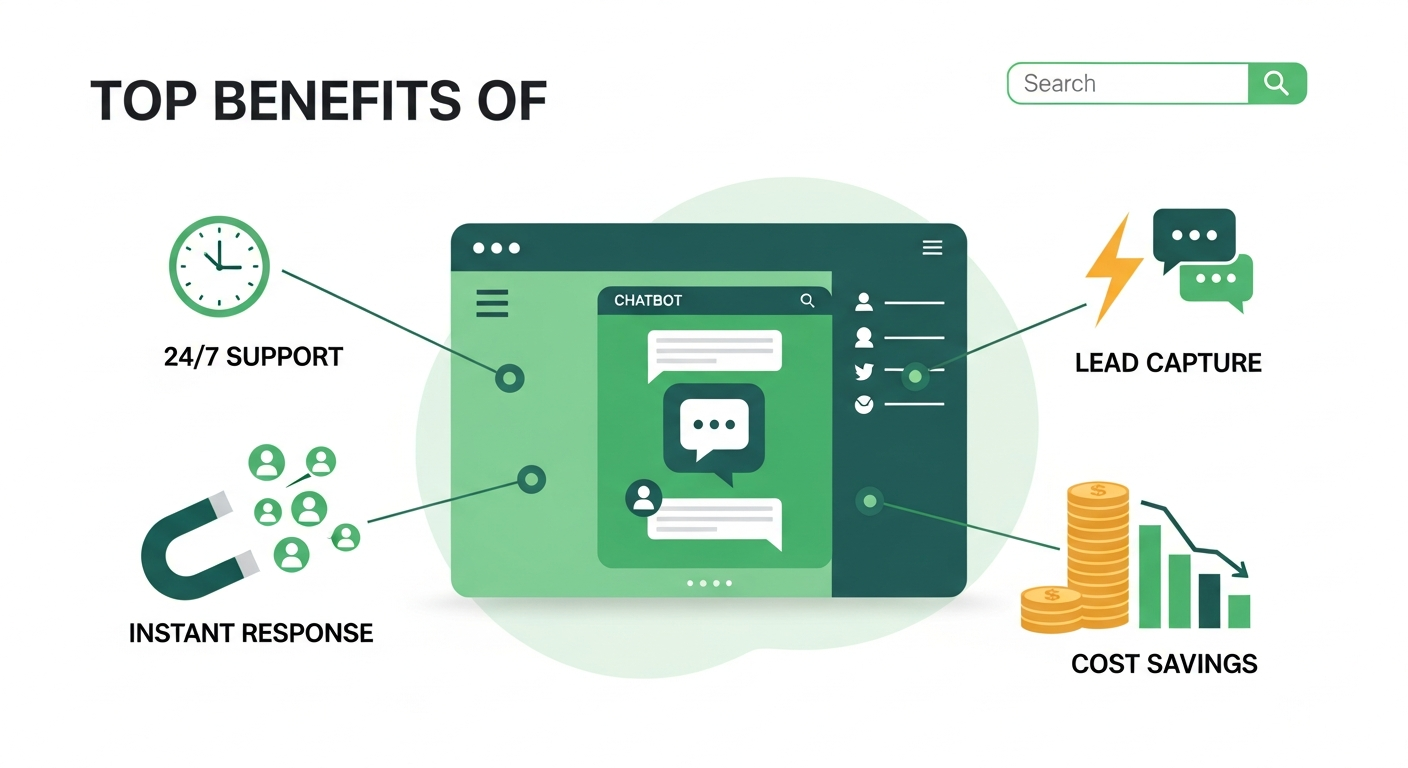
Top Benefits of Using an AI Chatbot on Your Website
1. 24/7 Customer Support Availability
An AI chatbot for website support ensures customers receive instant assistance at any time, reducing wait times and improving satisfaction.
2. Improved Lead Generation and Qualification
Chatbots can engage visitors, ask qualifying questions, and route high-intent leads directly to sales teams.
3. Higher Conversion Rates
By guiding users through decision-making processes, AI chatbots reduce friction and help convert visitors into customers.
4. Reduced Operational Costs
Automating repetitive support and sales inquiries lowers the need for large support teams.
5. Personalized User Experience
AI chatbots tailor responses based on user behavior, location, and browsing history, creating more relevant interactions.
How AI Chatbots Enhance Website User Experience
AI chatbots improve website UX by:
Providing instant answers without page navigation
Reducing bounce rates
Offering proactive assistance based on user actions
Supporting multilingual conversations
This leads to longer session durations and improved user engagement metrics.
Common Use Cases for AI Chatbots on Websites
AI chatbots for websites are widely used in:
E-commerce product recommendations
SaaS onboarding and customer support
Booking and appointment scheduling
Educational and informational websites
Customer feedback collection
These use cases demonstrate the flexibility of AI-powered chat solutions.
AI Chatbots vs Traditional Live Chat
Feature | Traditional Live Chat | AI Chatbot for Website |
|---|---|---|
Availability | Limited hours | 24/7 |
Scalability | Agent-dependent | Highly scalable |
Response Speed | Variable | Instant |
Cost Efficiency | Higher | Lower over time |
AI chatbots extend live chat capabilities by adding automation and intelligence.
How to Implement an AI Chatbot on Your Website
To deploy an AI chatbot for your website:
Define business goals (support, sales, lead capture)
Choose an AI chatbot platform with NLP capabilities
Train the chatbot using FAQs and historical data
Integrate with CRM and analytics tools
Monitor conversations and optimize responses
Proper setup ensures accurate responses and measurable results.
The Future of AI Chatbots for Websites
The future of AI chatbots for websites includes:
Voice-enabled website chatbots
Deeper personalization using behavioral data
AI agents capable of completing tasks autonomously
Seamless omnichannel customer journeys
As AI continues to evolve, website chatbots will become more intelligent and proactive.
Conclusion
Using an AI chatbot for website interactions helps businesses deliver instant support, generate more leads, and improve conversions while reducing operational costs. With advancements in conversational AI, website chatbots are becoming essential tools for scalable digital growth.
Implementing an AI chatbot today prepares your website for the future of customer engagement.