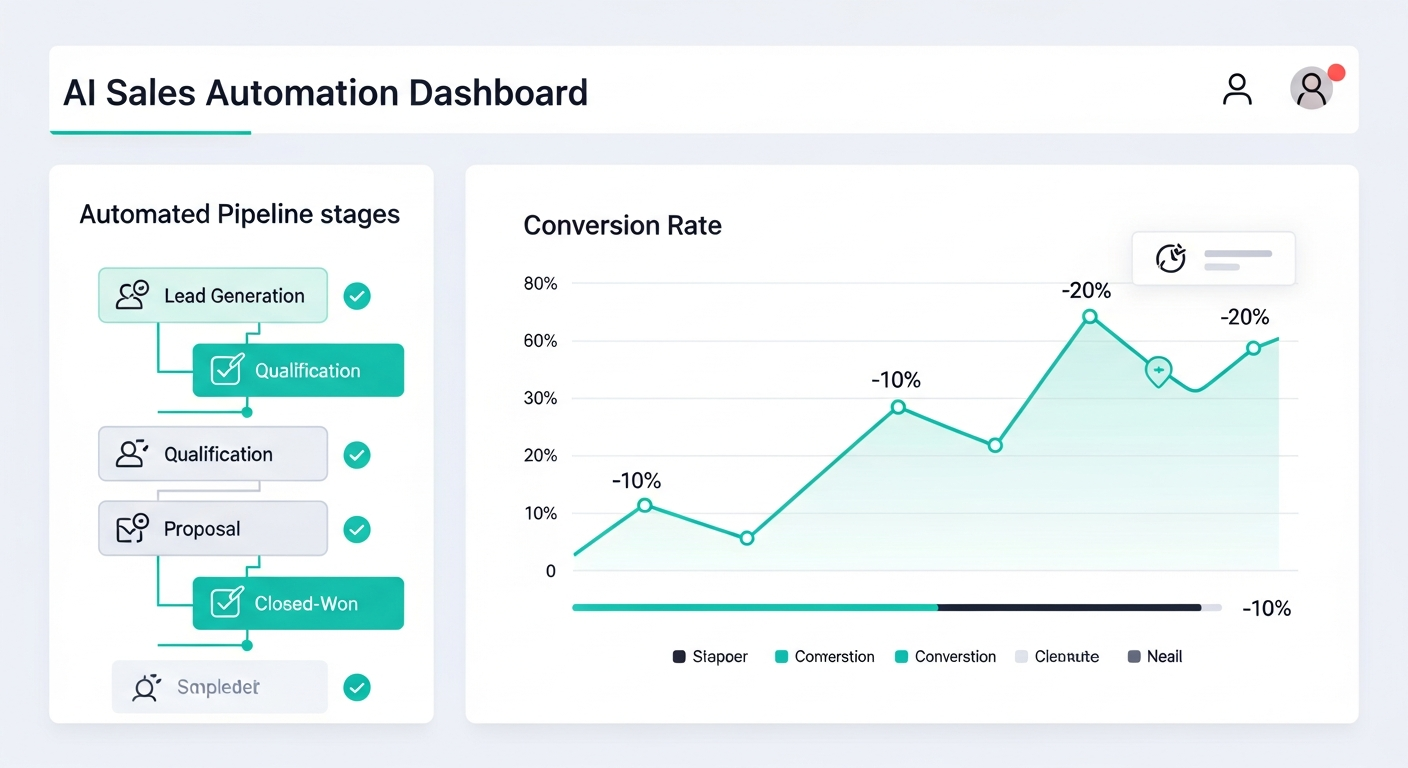
AI sales automation is transforming how small and medium-sized enterprises (SMEs) manage leads, engage prospects, and close deals. By combining artificial intelligence, machine learning, and automated workflows, businesses can reduce manual sales tasks while increasing conversion rates and revenue efficiency.
For SMEs with limited resources, AI-powered sales automation provides enterprise-level capabilities without the enterprise-level cost.
What Is AI Sales Automation?
AI sales automation refers to the use of artificial intelligence technologies to automate, optimize, and enhance sales processes such as:
Lead qualification and scoring
Customer segmentation
Sales outreach and follow-ups
CRM data enrichment
Sales forecasting and pipeline management
Unlike traditional sales automation tools, AI-driven systems learn from data, adapt over time, and make predictive decisions rather than following static rules.
Core Components of AI Sales Automation
AI sales automation platforms typically include the following elements:
1. AI-Powered Lead Scoring
Machine learning models analyze user behavior, demographics, engagement history, and intent signals to prioritize high-conversion leads automatically.
2. Intelligent CRM Automation
AI enhances CRM systems by:
Auto-updating contact data
Predicting deal outcomes
Recommending next-best actions
3. Automated Sales Outreach
AI can personalize email sequences, chat responses, and follow-ups based on customer behavior and buying stage.
4. Predictive Sales Analytics
Sales teams can forecast revenue more accurately using AI models trained on historical and real-time sales data.
How AI Sales Automation Increases Conversion Rates
AI sales automation improves conversions by optimizing every stage of the sales funnel:
Faster response times → higher lead engagement
Personalized communication → better customer trust
Accurate lead prioritization → higher close rates
Consistent follow-ups → reduced lead leakage
Instead of relying on intuition, sales decisions are backed by data-driven insights.
Benefits of AI Sales Automation for SMEs
For small and medium businesses, AI sales automation offers measurable advantages:
Reduced manual workload for sales teams
Lower customer acquisition costs (CAC)
Improved sales productivity
Scalable sales processes
Better customer experience
SMEs can compete with larger companies by leveraging automation and intelligence rather than increasing headcount.
Common Use Cases of AI Sales Automation
AI sales automation is commonly applied in:
B2B lead nurturing
SaaS subscription sales
E-commerce upselling and cross-selling
Customer retention and re-engagement
Sales chatbot automation
These use cases show how AI integrates across digital sales channels.
AI Sales Automation vs Traditional Sales Automation
Feature | Traditional Automation | AI Sales Automation |
Logic | Rule-based | Data-driven & adaptive |
Personalization | Limited | Dynamic & predictive |
Scalability | Manual updates | Self-learning models |
Insights | Descriptive | Predictive & prescriptive |
AI sales automation goes beyond automation by adding intelligence and continuous optimization.
How to Implement AI Sales Automation Successfully
To implement AI sales automation effectively:
Identify repetitive sales tasks
Choose AI-enabled CRM or sales tools
Integrate data sources (CRM, email, website, ads)
Train models with clean historical data
Monitor performance and refine workflows
A gradual rollout ensures adoption without disrupting existing sales operations.
The Future of AI Sales Automation
AI sales automation is evolving toward:
Autonomous sales agents
Real-time conversational AI
Hyper-personalized sales journeys
Deeper integration with marketing automation
As AI models become more advanced, sales teams will focus more on strategy and relationship-building rather than execution.
Conclusion
AI sales automation is no longer optional for SMEs aiming to grow efficiently. By automating repetitive tasks, improving lead quality, and enabling data-driven decisions, AI-powered sales automation helps businesses boost conversions while reducing operational friction.
Investing in AI sales automation today prepares SMEs for a more competitive, intelligent, and scalable sales future.