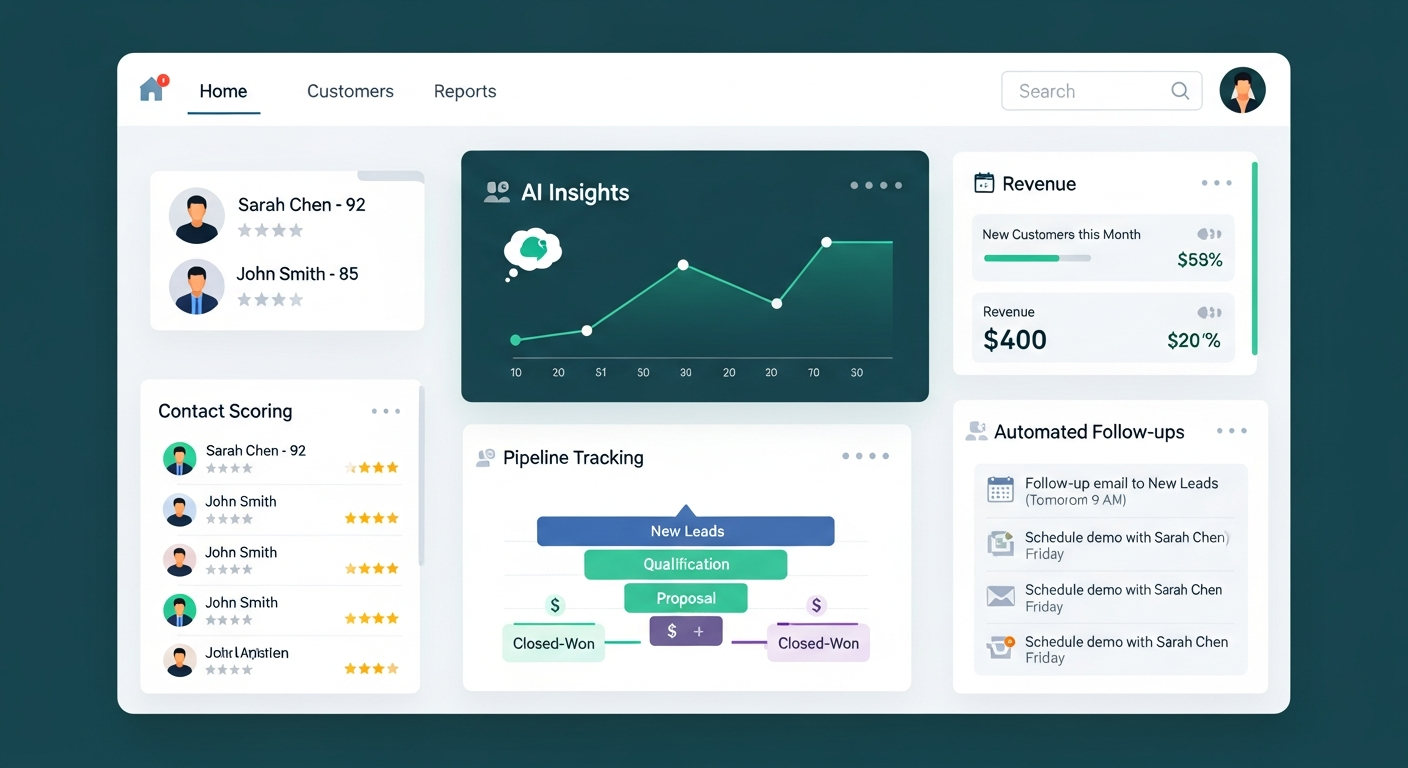
Managing customer relationships has never been more complex or more critical. Sales pipelines grow longer, customer expectations rise, and the window to act on a hot lead closes in seconds. Traditional CRM platforms were built for a slower era. Today, businesses need AI CRM software that thinks, predicts, and acts alongside their teams.
Artificial intelligence has fundamentally changed what customer relationship management software can do. From automated lead scoring and predictive analytics to conversational AI and intelligent workflow automation, modern AI-powered CRM tools have become essential infrastructure for growth-oriented businesses.
In this guide, we'll explore how AI CRM software works, what features matter most, how leading platforms are applying artificial intelligence to sales and marketing, and how businesses of all sizes from startups to enterprise are using these tools to build deeper, more profitable customer relationships.
What Is AI CRM Software?
AI CRM software is a customer relationship management platform that integrates artificial intelligence and machine learning to automate tasks, surface actionable insights, and personalize customer interactions at scale. Unlike legacy CRM systems that merely store contact data and interaction histories, AI-driven CRM platforms actively analyze that data to help sales teams prioritize efforts, predict outcomes, and engage customers at the right moment.
Core capabilities of an AI CRM system typically include: predictive lead scoring, natural language processing (NLP) for customer communication analysis, automated data entry, intelligent pipeline management, sales forecasting, and AI-assisted recommendations for next best actions.
The distinction from traditional CRM is significant. A conventional CRM is reactive it records what happened. An AI CRM is proactive it tells you what's likely to happen next and what you should do about it.
Key Features to Look for in AI CRM Software
Not all AI CRM platforms are created equal. When evaluating options, these are the features that deliver the most measurable value:
Predictive Lead Scoring
AI-powered lead scoring moves beyond simple rule-based qualification. Machine learning models analyze historical win/loss data, behavioral signals, firmographic attributes, and engagement patterns to assign dynamic scores that reflect the true likelihood of conversion. Sales teams can focus their time on prospects most likely to close, dramatically improving efficiency and win rates.
Intelligent Sales Forecasting
Accurate revenue forecasting is one of the most persistent challenges in sales management. AI CRM systems use regression analysis, deal velocity metrics, and pattern recognition to generate forecasts that are more accurate than manual estimates. Some platforms integrate external signals market conditions, seasonal trends, competitor activity to further refine predictions.
Automation and Workflow Intelligence
Modern AI CRM tools automate repetitive, time-consuming tasks that drain sales and support teams. These include:
Automatic data capture from emails, calls, and web interactions
Follow-up reminders triggered by customer behavior
Intelligent email sequencing and personalization at scale
Routing incoming leads to the right sales rep based on fit
Drafting customer communication using generative AI
Natural Language Processing and Sentiment Analysis
Advanced AI CRM platforms use NLP to analyze the tone, intent, and sentiment of customer communications from support tickets and emails to call transcripts and chat messages. This empowers teams to identify at-risk accounts before churn occurs, detect buying signals in conversational data, and personalize outreach based on emotional context.
Customer 360 and Unified Data Profiles
The best AI-powered CRM systems aggregate customer data from multiple touchpoints marketing, sales, support, billing, and product usage into a single, real-time customer profile. AI enriches these profiles continuously, filling gaps and surfacing insights that would be invisible in siloed systems. This unified view is essential for delivering the personalized experiences today's customers expect.
The Business Benefits of AI-Powered CRM
Investing in AI CRM software delivers compounding advantages across the entire revenue lifecycle. According to Salesforce's State of Sales report, high-performing sales teams are 4.9x more likely to be using AI in their CRM workflows. The tangible outcomes span several dimensions:
Higher conversion rates through better lead prioritization and timely follow-ups
Shorter sales cycles by identifying deal-blockers earlier in the pipeline
Reduced customer churn via proactive health scoring and early intervention
Increased sales rep productivity by eliminating manual data entry and admin tasks
More accurate revenue planning through AI-driven forecasting models
Personalized customer journeys that improve satisfaction and lifetime value
These benefits are not limited to enterprise organizations. Mid-market and small businesses increasingly have access to AI CRM capabilities through cloud-based platforms with flexible pricing, making the technology accessible at virtually every growth stage.
How Leading Platforms Are Applying AI to CRM
The AI CRM software landscape has expanded rapidly, with both established vendors and innovative challengers deploying artificial intelligence in distinct ways.
Salesforce Einstein AI
Salesforce has embedded AI deeply into its CRM ecosystem through Einstein AI, which powers predictive scoring, opportunity insights, automated activity capture, and the Einstein Copilot conversational AI assistant. For enterprise teams with complex sales motions, Einstein provides a deeply integrated AI layer across the entire Salesforce platform.
HubSpot AI Features
HubSpot has introduced AI-powered features including content generation, predictive lead scoring, and conversation intelligence into its CRM platform. Its strength lies in ease of use and tight integration between marketing, sales, and service hubs making it particularly effective for inbound-focused growth teams.
InCard: AI-Powered Relationship Intelligence for Modern Teams
An emerging name worth watching is InCard (incard.biz), a platform that takes a relationship-intelligence-first approach to AI CRM. InCard focuses on helping sales and business development teams turn every customer interaction into actionable relationship data. Rather than overwhelming users with dashboards and configuration, InCard applies AI to surface what matters: who to reach out to, when, and what to say.
For teams that value simplicity without sacrificing intelligence, InCard represents a compelling alternative to heavier enterprise CRM solutions. Its AI layer is designed to work in the background enriching contact profiles, tracking relationship health, and prompting reps at the right moments so teams spend more time building relationships and less time managing software.
Zoho CRM and Zia AI
Zoho CRM's built-in AI assistant, Zia, offers anomaly detection, sales predictions, sentiment analysis on customer emails, and intelligent automation suggestions. Zoho's competitive pricing and extensive customization options make it a strong choice for small and mid-sized businesses seeking AI CRM capabilities without enterprise-level investment.
Choosing the Right AI CRM Software for Your Business
Selecting an AI CRM platform is one of the most consequential technology decisions a growing business can make. Here's a framework to guide your evaluation:
Define Your Core Use Case First
Are you primarily solving a sales pipeline problem, a customer retention challenge, or a marketing personalization need? Different AI CRM systems are optimized for different use cases. Clarity on your primary goal will narrow the field quickly.
Assess Your Integration Requirements
AI CRM software is only as valuable as the data it can access. Ensure any platform you evaluate integrates cleanly with your existing tech stack — email, calendar, marketing automation, ERP, customer support tools, and communication platforms like Slack or Teams. Poor data connectivity is the single most common reason AI CRM deployments underperform.
Evaluate AI Transparency and Explainability
AI recommendations are only trustworthy if your team understands the reasoning behind them. Look for AI CRM platforms that explain why a lead was scored high, why a deal was flagged at risk, or why a particular follow-up action was recommended. Explainable AI drives adoption when reps trust the AI, they act on its recommendations.
Prioritize Ease of Adoption
The most sophisticated AI CRM platform is useless if your team doesn't use it consistently. Evaluate onboarding support, mobile experience, UI simplicity, and the quality of documentation. Platforms that embed AI assistance naturally into existing workflows rather than requiring users to seek it out achieve far higher adoption rates.
The Future of AI CRM: What's Coming Next
The pace of AI innovation in CRM software shows no signs of slowing. Several trends are poised to reshape the landscape in the coming years:
Generative AI for autonomous email drafting, proposal generation, and meeting preparation will become standard across all major CRM platforms
Agentic AI systems capable of taking multi-step actions on behalf of sales reps will handle pipeline hygiene, outreach scheduling, and deal progression autonomously
Voice AI and real-time call coaching will be embedded directly into CRM interfaces, providing in-the-moment guidance during customer conversations
Hyper-personalization at scale will use AI to tailor messaging, timing, and channel selection for every individual customer based on behavioral and contextual signals
AI-driven customer health scoring will enable proactive retention programs that identify and address churn risk weeks before it manifests
Businesses that embed AI CRM capabilities into their revenue operations now will be better positioned to capitalize on these advances as they mature and will find themselves with a compounding competitive advantage over those who delay adoption.
Conclusion: AI CRM Software Is No Longer Optional
AI CRM software has moved from a competitive differentiator to a business necessity. In a world where buyers are better informed, attention is scarce, and relationships are the ultimate moat, the ability to manage customer interactions with intelligence and precision is what separates high-growth businesses from those that plateau.
Whether you're a startup building your first sales process, a mid-market company scaling a revenue team, or an enterprise organization optimizing a complex customer lifecycle, there is an AI CRM solution designed to meet you where you are.
The right platform whether that's Salesforce Einstein for enterprise scale, HubSpot for inbound-led growth, Zoho for budget-conscious teams, or relationship-intelligence-focused tools like InCard (incard.biz) for teams who want AI that works behind the scenes — will help your team spend less time on admin and more time doing what actually drives revenue: building genuine, lasting customer relationships.
Start by auditing your current CRM workflows, identifying where time is wasted and where insights are missing, and use those gaps to guide your evaluation. The best AI CRM software is the one your team will actually use — and that will grow smarter the more they do.