
Agentic AI is a way of organising an AI system so that it pursues a multi-step goal on its own: it takes in the facts, makes a plan, uses tools to act, verifies the result, and brings in a human only at checkpoints defined in advance. The difference is the level of autonomy it is given: a chatbot replies from a script, an AI agent carries out one assigned task, and an agentic AI system owns the whole chain of work until there is an outcome.
The three terms are often used as if they were interchangeable, because all three run on the same kind of AI model. But the workload they take off your team is very different. If you are not yet clear on what an AI agent is, that article covers the task level; this one goes one level up, to the chain of work.
Key takeaways:
- The difference between a chatbot, an AI agent and agentic AI is the level of autonomy handed over, not how smart the model is.
- An agentic AI system runs on a five-beat loop: take in the facts, plan, act through tools, verify the result, and call a human at the checkpoint.
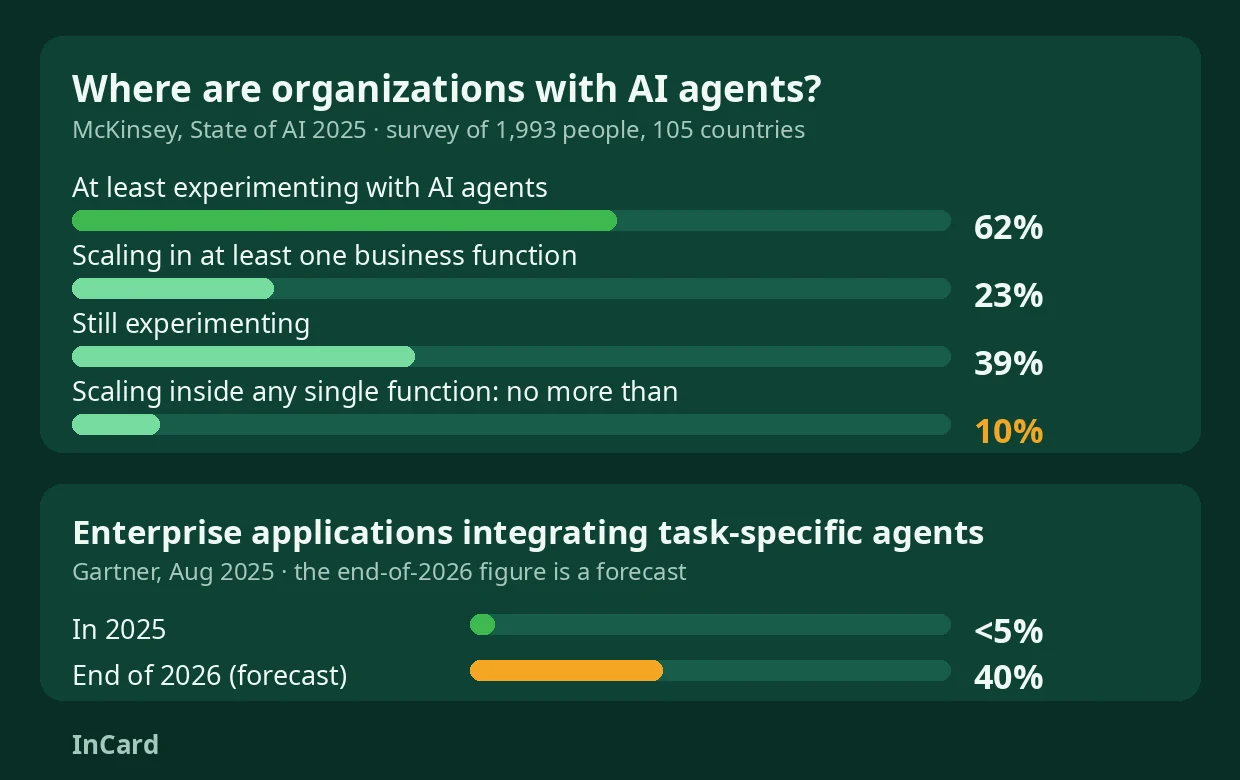
- The market is experimenting fast but scaling narrowly: 62 percent of organizations have tried AI agents, yet no single business function has more than 10 percent scaling them (McKinsey, 2025).
- Hand a chain of work to agentic AI only when the process already runs well by hand, the facts live in one trustworthy source, and a named human owns the checkpoint.
How does agentic AI differ from a chatbot and an AI agent?
The core difference is not how smart the model is. It comes down to four things: how much discretion the system gets, whether it can use tools, whether it verifies its own results, and when it stops and calls a person.
| Criteria | Chatbot | AI agent | Agentic AI |
|---|---|---|---|
| How it works | Replies from scripts and loaded content | Carries out one specific assigned task | Plans multiple steps on its own to reach a goal |
| Level of autonomy | None; it only responds when asked | Within a single task | Across a whole chain of work, inside a defined safe zone |
| Tool use | Almost none | Yes, within its task | Yes; it picks the tool each step needs: price lookup, CRM entry, messaging, scheduling |
| Result verification | None | Limited, depends on the build | A dedicated verification step before moving on |
| When it calls a human | Anything off-script | When the task gets stuck | Only at preset checkpoints: price approvals, confirmed commitments, exceptions |
A short way to remember it: a chatbot answers a question, an AI agent does a job, agentic AI pursues an outcome. Most staff time is burned at that third level, because real work rarely fits into a single step. Underneath all three sits the same conversational layer; our guide to conversational AI explains how it understands a request and responds in natural language.
Where does agentic AI stand in the market?
The most telling numbers are not about enthusiasm. In McKinsey’s State of AI 2025 report, drawn from a survey of 1,993 participants across 105 countries, 62 percent of organizations are at least experimenting with AI agents: 23 percent are scaling an agentic AI system somewhere in the business, and 39 percent are still experimenting. Zoom into any single business function, though, and no more than 10 percent of organizations are scaling agents there.
On the software side, Gartner forecasts that task-specific AI agents will be integrated into 40 percent of enterprise applications by the end of 2026, up from less than 5 percent in 2025. The same firm also warns that more than 40 percent of agentic AI projects could be cancelled by the end of 2027, over escalating costs, unclear business value and inadequate risk controls.
Interest has clearly outrun controlled deployment. What separates the projects that survive from the ones that get cancelled is rarely a stronger model. It is the data access, the authority limits and the human checkpoints, which is exactly what the next section takes apart.
What loop does an agentic AI system run on?
There is no magic behind it. An agentic AI system runs on a loop of five beats, and its quality depends on how tightly each beat is built.
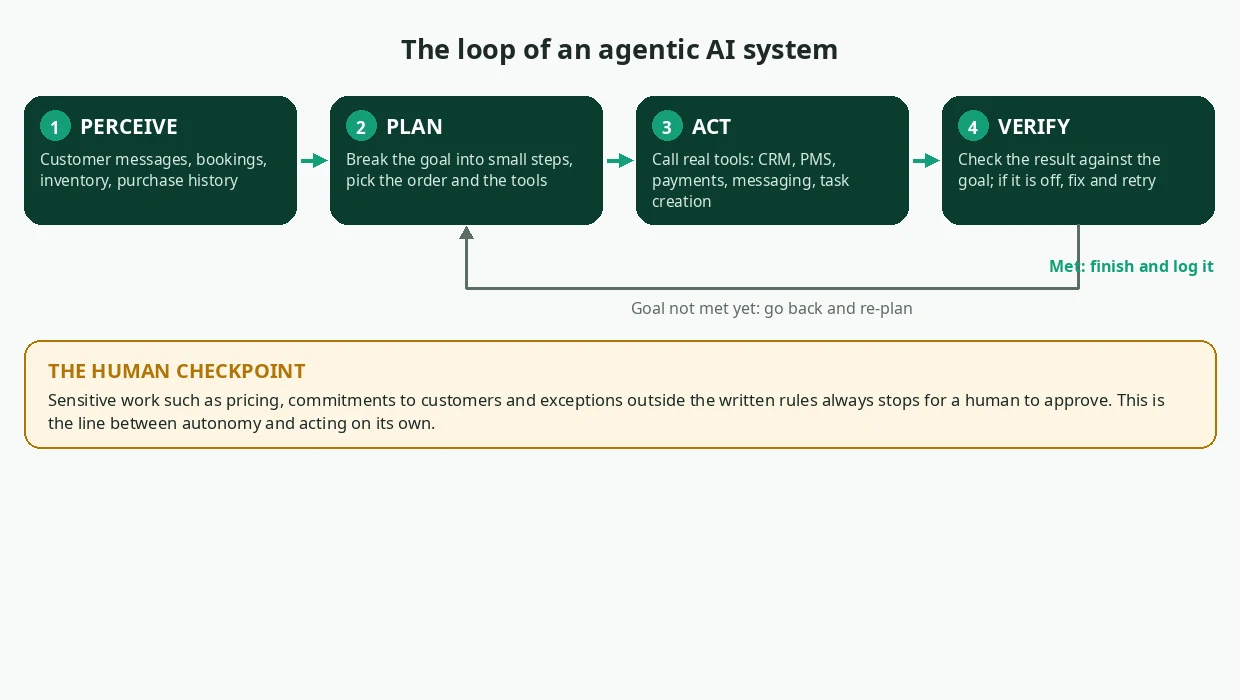
- Take in the facts. The system reads the real inputs of the job: the customer’s message, order data, open slots, stock levels, pricing policy. Facts come from the systems you actually run on, not from the model’s memory.
- Plan. From the goal it was given, the system breaks the work into ordered steps, works out which step needs which tool, and marks which steps must stop and wait for a person.
- Act through tools. It executes each step with real tools: looking up a price, creating a record in the CRM, sending a message, booking an appointment. Every action leaves a trace that can be audited later.
- Verify. Before moving on, it checks the result against the conditions set for the job: does the amount match the quote, does the appointment clash with a staff shift, is the customer information complete. If something is off, it goes back a beat and fixes it there, instead of passing the error down the chain.
- Call a human at the checkpoint. When the work leaves the safe zone, the system stops and hands over to the person in charge, with a summary of everything it has done so far. The human only has to judge the one point that needs judgement.
The verification beat and the checkpoint are what separate a system that survives real operations from a demo that merely looks impressive. Without them, more autonomy just means more risk.
Example: one customer care chain, run end to end by agentic AI
Take a familiar chain of work at a small business that sells through Facebook and Zalo, where a support team of three has to cover chat late into the evening. A customer messages at 9 p.m., asking to buy a product and have it delivered the next morning.
The system reads the message and recognises a purchase enquiry, not a general question. It checks the live price list and stock, confirms the exact model is available, and asks for an address to work out delivery. The customer sends the address; the system checks it against the delivery policy, confirms next-morning delivery works, and quotes the right fee.
The customer agrees. The system creates a draft order in the CRM, sends a payment link, and logs the whole conversation so the team sees it first thing in the morning. Then the customer asks for a further discount. That sits outside the approved price range, so the system stops and hands the conversation to the person in charge, with a summary: who the customer is, what has been agreed, and exactly where the price is stuck.
In this chain, a human touches exactly one point, the one that needs commercial judgement. Everything else, from the price lookup and the policy check to the order entry, runs without anyone watching the screen. This is the work an AI sales agent covers on the pre-sales stretch; agentic AI is the organising layer that ties agents like it into one verified chain.
Chains like this are no longer paper examples. At a bio-fertiliser producer, InCard’s system runs a multichannel consulting chain every day: customers ask across channels, the system checks the data, drafts advice under the approved process, and hands over to a human only at the points that need a decision. The whole chain is told in the customer story on AI multichannel consulting.
If you would rather see this loop run on real data than read about it, look at how the InCard platform organises agents around each business’s own processes. InCard builds the demo on your operation’s actual chain of work before anyone talks about rollout.
When does a business not need agentic AI yet?
Newer does not mean better suited. There are four situations where agentic AI is not the right move:
- The work has only one step. Customers asking for opening hours, an address, or how returns work. A regular chatbot handles these well; a multi-step system only adds cost and more places to break.
- There is no single source of facts. Prices recorded differently in different places, stock kept in a paper notebook, a delivery policy every staff member understands differently. The system has nothing trustworthy to verify against, and it will act confidently on wrong data.
- Nobody owns the checkpoint. Agentic AI needs a real person who takes the handed-over cases and approves at checkpoints. If nobody holds that role, the checkpoint becomes a bottleneck, which is worse than doing the work manually.
- The process still changes every week. Automating a chain that has not settled yet means the system amplifies the mess at machine speed.
If any of these apply, the right path is to start smaller: one AI agent for one clearly defined task, run it until it is stable, then think about chaining. That order looks slower in a presentation. It holds up far better in daily operations.
What should you prepare before handing work to agentic AI?
Three things, in order from essential to optional:
- A chain of work that already runs well by hand. A system only automates well what is already clear: what the input is, what the steps are, and what a correct result looks like.
- One trustworthy source of facts. Price lists, stock, policies and rosters need to live in one place the system can reach. This is usually the most laborious part of the preparation, and it is also the part that decides the quality.
- Checkpoints, and a named person who owns them. Write down what the system may decide alone, what must stop for a human, and who receives those cases. The clearer the safe zone, the more autonomy you can safely hand over.
“Do not start by asking which technology to buy. Start with the one chain of work that eats the most staff time every day, let the system run it inside a narrow safe zone, and keep a human on the checkpoint.”
— Tam Ho, Founder, InCard
From workflow automation to agentic AI: where the line sits
Many businesses arrive at agentic AI from workflow automation, and the two are often confused. Workflow automation connects steps with fixed rules: when this happens, do that. It handles work that is structured and predictable well — moving data from one system to another, triggering a follow-up when a condition is met, filling a form with known inputs. Its weakness is brittleness: any variation in input or process can break the chain, because the chain has no way to judge what to do instead.
AI steps inside a workflow soften that brittleness. The system can read and classify unstructured input — an email, a support ticket, a scanned document — decide which route a case should take based on context rather than a fixed threshold, and draft the communication the workflow then sends. A routine enquiry and a high-value complaint no longer have to travel the same path just because they arrived through the same form.
The step from there to agentic AI is about who holds the plan. In workflow automation, people design every step in advance and the system executes them. In an agentic setup, the system is given a goal and the boundaries around it, breaks the work into steps itself, uses tools to carry them out, checks the result, and only involves a person at the checkpoints that were agreed in advance. The practical test: if an unexpected case requires a person to redesign the process before anything can proceed, you are looking at workflow automation. If the system can adapt its route within its boundaries and escalate the rest with context, you are looking at agentic AI.
Where agentic AI fits in a small business
The small-business version of agentic AI is narrower than the enterprise picture, and that is a strength. A small team does not need an agent that does everything; it needs one painful, recurring job taken off the desk reliably. Four areas usually come first.
Customer messages and support. Answering the same questions every day — prices, opening hours, order status, return policies — and escalating the rest to a person with the conversation history attached. This is usually where a small business feels the return fastest, because the work is frequent, patterned and easy to check. Even before agents enter the picture, a well-scoped chatbot already pays for itself — the main benefits of AI chatbots on a business website are the baseline most small businesses start from.
Sales follow-up. Making sure every enquiry gets a fast first reply and the follow-ups actually happen, instead of depending on someone remembering a spreadsheet. The agent drafts in the business’s own voice; a person approves anything that commits the business.
Content and scheduling. Drafting posts and routine content from the business’s own material, then preparing them for the channels the business already uses, so a consistent presence does not depend on finding a spare hour every day.
Reading the business back to itself. Summarising sales and enquiry data in plain language: which products are asked about most, where enquiries stall, what customers keep requesting. No new system to learn — the answer arrives in the tools the owner already opens.
The starting rule is the same one this guide gives for any rollout: audit the tasks, pick the single most time-consuming one, and start there. A small business that runs one chain well learns more, and risks less, than one that tries to automate everything at once. For the wider sequence — which parts of the business to bring along first and how to measure the return — see our guide to digital transformation for SMEs.
For most small businesses, the practical question is not whether to use an agent but how much of it to own. The honest options, and what each one costs to maintain, are laid out in our guide to custom AI agents for SMEs: build, configure or buy.
Frequently asked questions about agentic AI
How is agentic AI different from an AI agent?
In the scope of what it owns. An AI agent carries out one specific assigned task, for example answering and logging a customer request. Agentic AI owns the whole chain of work until there is an outcome: it plans multiple steps on its own, uses tools, verifies each intermediate result, and brings in a human only at checkpoints defined in advance.
Does a small business need agentic AI?
Only if it has a multi-step chain of work that eats staff time every day, the kind that runs from enquiry to order to after-sales care, and that chain already runs well by hand. For one-step work, a chatbot or a single AI agent is enough; a multi-step system only adds cost and more places to break.
What should be prepared before rolling out agentic AI?
Three things: a chain of work with a clear input, clear steps and a clear standard for a correct result; one unified source of facts for prices, stock, policies and rosters; and written checkpoints that state what the system may decide alone, what must stop for a human, and the named person who owns those cases.
Where to start
If your business has one chain of work that eats staff time every day, the kind that runs from enquiry to order to after-sales care, that is where agentic AI is worth trying first. InCard builds a demo that runs on your own business’s real processes and data, so you can watch the loop complete a full chain of work before deciding on a rollout.
Read more about the task level in what an AI agent is, see a self check-in chain running live in the Weal Apartment story, or book a demo to talk through your own chain of work directly.
The same loop shows up in less obvious industries. An Australian firm uses it for real estate investment consulting, and a home-building business for building and feng shui consulting — in both cases the system prepares the advice and a person approves it before it reaches the client. Autonomy like this only earns trust when the guardrails are public: InCard’s trust pages set out the security and compliance terms the platform runs under.
Two follow-on reads go deeper on the sales side: lead nurturing automation for the follow-up chain, and agentic AI for sales and marketing for seven workflows with their human checkpoints. The conversational layer underneath is mapped in the conversational AI platform guide and the sharper distinction in conversational AI platform vs chatbot, while personalizing sales messages with AI covers what the system should say once it knows the customer. Teams comparing vendors can use AI platforms for business, compared as the checklist, and the rest of this series sits under AI automation.
Tam Ho is the Founder of InCard, the agentic AI platform for small and mid-sized businesses in Vietnam. He works directly with operations teams to bring each chain of work onto the system, with a human keeping the checkpoint on the decisions that matter.