
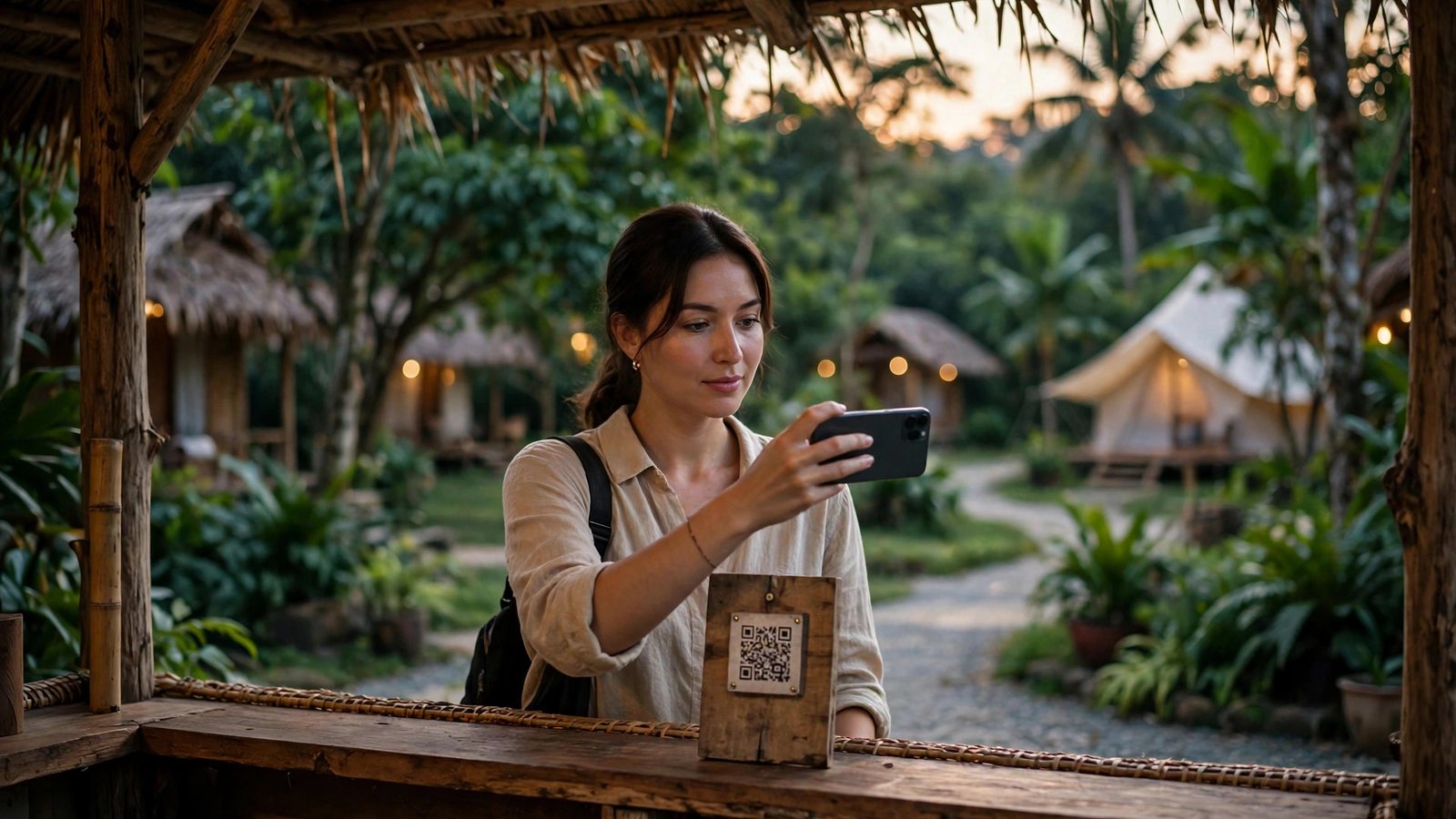
An eco tourism site that has always hosted day visitors has just added lodging, and it immediately ran into a problem traditional hotels do not have: its guests arrive from three sources with completely different behavior, while the front desk is a single small counter with a thin team. OTA guests can show up in the middle of the night. Guests asking on the fanpage and Zalo need answers outside office hours before they commit to a room. And the largest group of all, visitors already on site for the day, will decide to stay the night on the spot, if they can see an available room and finish booking in a few minutes on their phone.
This article records the problem and the plan proposed for the property: one AI assistant handling consulting, booking and self check-in across every channel, wired straight into the property management system already in use. It is anonymized under the rule for proposal-stage customers, and it states no results, because there is no live system yet to measure.
Key points
- Three guest sources (OTA, direct chat channels, on-site day visitors) need three different approaches that must still flow into one single check-in process.
- The AI assistant learns from the property’s own data: room types, prices, more than 20 tours and seasonal experiences, local food, regional specialties, policies and directions.
- Self check-in has two entry points, a pre-arrival link or a QR code at the desk, running through one verification and update flow in the management system.
- OTA guests are a structural blind spot: the platforms do not let outside software message inside their systems, so the check-in link has to live inside the property’s own message templates.
- Every room consultation doubles as a chance to introduce tours and experiences, because guests come to this kind of property for the experiences; the bed is only half of what they are buying.
The setting: when a day attraction becomes a place to stay
The new lodging side has three room types with very different characters: glamping tents, a traditional house and countryside-style guest rooms. The guests differ just as much by source.
Guests from OTAs such as Booking.com and Agoda are used to booking and paying online. They need a fast arrival, and their arrival time often falls far outside front desk hours because the journey to the site is long.
Guests from the fanpage, website and Zalo ask a lot before booking: which room suits their group, what experiences are worth doing in the month they come, what they should eat on site. Questions scatter across evenings and weekends. An answer delayed by a few hours usually means the guest has booked somewhere else.
On-site day visitors are the most distinctive group. They came for a day tour, then decide to add a night while standing inside the property. That decision only converts into a booking if they can see tonight’s availability and complete the booking on their phone, right there.
What all three groups share: none of them tolerates an old-style arrival, queuing at a counter while a staff member types each guest’s details in by hand. And because guests come to an eco site for experiences, the accompanying advice matters more than at an ordinary hotel: suggesting the right seasonal tour is worth nearly as much as selling the extra night.
The problem: a thin front desk against three kinds of guest behavior
Walking through the planned operation with the property’s team surfaced four bottlenecks.
One, consulting questions arrive on three channels at once, peaking outside office hours. A human assistant cannot watch a fanpage, Zalo and a website all evening, and a newly opened lodging operation cannot yet carry the cost of a night shift.
Two, late arrivals. OTA guests reaching the site late at night need to get into their room immediately, but the front desk is not staffed around the clock. Keeping someone on site all night for a few late arrivals is wasteful; leaving guests waiting is a bad first minute of the stay.
Three, availability data has to be real at the moment of advice. Wrong availability, whether a person or a machine gave it, ends in double bookings or empty promises. The only trustworthy source is the property’s management system, where bookings from every channel converge.
Four, guest registration paperwork is still a legal duty. Self check-in removes desk work, not the obligation to record guest information. The automated flow has to collect full names and ID photos, then pass the data into the management system so the front desk can complete the official guest registration.
The proposed plan: one AI assistant, four jobs
The proposal is to build a single AI assistant for the property, present on the website, the fanpage, Zalo and QR codes placed around the grounds. The assistant learns from the property’s own data: room types and seasonal prices, a list of more than 20 tours and experiences with their monthly calendar, signature dishes, local specialties to take home, policies and directions. Its four jobs:
| Job | What the AI assistant does | Why it matters at an eco property |
|---|---|---|
| Consult and book rooms | Suggests a room type by group size, checks availability in the management system, creates the booking, sends a payment QR code | Answers immediately, even at night, so evening inquiries are not lost |
| Advise on seasonal services | Suggests tours by the month of the visit, full-day combos, signature dishes and take-home specialties | Guests come for experiences, so room advice paired with an itinerary matches the real need |
| Self check-in | Collects guest details and ID photos, takes the remaining payment, sends room access guidance | Late guests complete arrival on their own, and the desk stays light at peak hours |
| Support during the stay | Answers questions, reminds guests of tour times, takes extra orders for food, tours and gifts, guides checkout, invites a review | More in-stay revenue and more positive reviews afterwards |
One boundary was set inside the scope: groups, school trips, weddings and special requests do not run through the automated flow. The assistant records group size, dates and budget, then hands over to a sales staff member for a separate quote, because those deals need negotiation and custom design.
The whole flow runs on one data source, the property’s KiotViet management system: availability, bookings including OTA bookings synced through the channel manager, guest records, invoices and service orders. The AI assistant is the conversation and processing layer on top; it does not create a second, parallel ledger next to the system already in operation. This follows the principle set out in the pillar guide to AI self check-in for hotels: automate the procedure, keep people for judgment and care.
The self check-in flow: two doors in, one process
Guests start in one of two ways, depending on where they came from.
The first way is the pre-arrival link. Direct bookings receive the check-in link in their confirmation message. OTA bookings receive the same link inside the message template the property sends through the platform, because OTAs do not open their messaging systems to outside software. The guest completes everything at home before travel day and walks straight to the room on arrival.
The second way is a QR code at the desk. Guests who have not checked in beforehand, and day visitors who decide to stay on the spot, scan a QR code placed at the reception counter and the site entrance, and complete the process on their own phone without queuing for manual data entry.
Both doors lead into the same five-step process:
| Step | What happens |
|---|---|
| 1. Verification | The guest enters a booking code or phone number, matched against the management system |
| 2. Guest details | Full names and ID photos for everyone staying |
| 3. Payment | The remaining balance is paid by QR transfer, confirmed automatically when the money lands |
| 4. Room access | The guest receives the room number and access guidance, or a staff member walks them over, depending on room type |
| 5. Update | The booking status flips to checked in inside the management system, and guest data is ready for the official registration step |
This table doubles as a build checklist: a property can hold its current arrival process against these five steps to find the step still done by hand for no reason.
During the stay, the same assistant keeps taking requests: a guest asks what is on tonight, and gets suggestions from the property’s experience calendar; extra tours, dishes or gifts are ordered straight into the management system and added to the room bill. At departure, the assistant sends checkout guidance and invites a review.
The in-stay requests follow the same pattern as booking. A guest asks what is happening tonight; the assistant answers from the property’s own calendar, a night experience on the water, a traditional music performance, the dishes the kitchen is known for, and takes the order inside the same conversation. The order lands in the management system and joins the room bill, so the guest settles everything once at checkout instead of paying in fragments across the site. None of this needs a staff member standing at the desk when the question arrives, which at a small property is exactly when these questions come: after dinner, when the desk has gone quiet.
What the property has to prepare
The proposal is explicit that the assistant is only as good as the material it is trained on, and most of that material belongs to the property: room types with weekday, weekend and seasonal prices, check-in and checkout times and the cancellation policy; the full list of tours, combos, menus and take-home specialties with prices; access to the management system and its API; admin rights on the fanpage and the messaging accounts so the assistant can be attached; a QR payment account; and the lock type fitted on each room type. Gathering this list is unglamorous work, and it is also most of the implementation risk. Properties that treat it as a one-afternoon task usually discover the gaps through their first guests.
Boundaries that were agreed up front
An honest note on this case: this is a plan at proposal stage. Everything described is a recorded problem and a proposed scope, not an operating result. The article states no improvement rates, because there is no running system to measure yet.
Three boundaries were written into the proposal itself.
First, the OTA channel has a hard limit. The platforms do not let external software message inside their systems, so any design promising to serve OTA guests inside the platform’s own app is not telling the truth. The workable route is to place the check-in link in the property’s message templates and let the guest step onto the property’s own channel from there.
Second, the room handover for glamping tents has to be settled after an on-site survey of the tent doors: code locks, lock boxes or a staff escort. A small physical detail like that decides whether the final step of the automated flow can truly close, and it cannot be decided on paper.
Third, the human front desk does not disappear in this model. Staff are relieved of data entry and after-hours message duty, so they can be present for the work machines do badly: receiving groups, handling on-site incidents and looking after guests through the live experiences.
How this differs from a conventional hotel or resort
This pattern is worth studying for properties with two traits: day visitors make up a large share of traffic and can convert into overnight guests the same day, and experience revenue matters as much as room revenue. Eco tourism sites, agri-tourism experiences and attractions with small lodging attached usually have both.
For an urban hotel or a pure leisure resort, the problem points the other way: guests come almost entirely from advance booking channels, and the value sits in direct, personal front desk service. InCard’s published lodging cases, such as the Weal Apartment AI self check-in story, work on that variant. The case in this article is the remaining one: check-in that also has to serve guests who had not booked anything before they set foot on the property.
Read next
- AI self check-in for hotels: the automated arrival process, which steps belong to machines and which stay with the front desk.
- Hospitality and travel: the full picture of InCard’s lodging solutions.
- Weal Apartment: AI self check-in: a serviced apartment running the advance-booking variant of the same flow.
- All customer stories: the published case library.
If your property has also just added lodging next to a day-visit operation, the practical next step is a demo of the hardest flow: a late guest checking in by link and by QR code, running on your own room data in your management system. Book through the demo page and the InCard team will build the flow on your actual room types and experience list so you can judge it before deciding on scope.
The assistant in this plan is an AI agent in the strict sense: it takes a goal, works through steps and reports back. If the term is still fuzzy, what is an AI agent draws the line between agent, chatbot and assistant. Properties that have already made the move describe it in their own terms: a boutique hotel group that paired self check-in with direct booking, a resort running a virtual receptionist alongside its restaurant, an owner-run homestay automated end to end, and a 20-room guest house that replaced its paper notebook with self check-in.
Tam Ho is the Founder of InCard, the agentic AI platform for small and mid-sized businesses in Vietnam. He works directly with operations teams to bring each chain of work onto the system, with a human keeping the checkpoint on the decisions that matter.