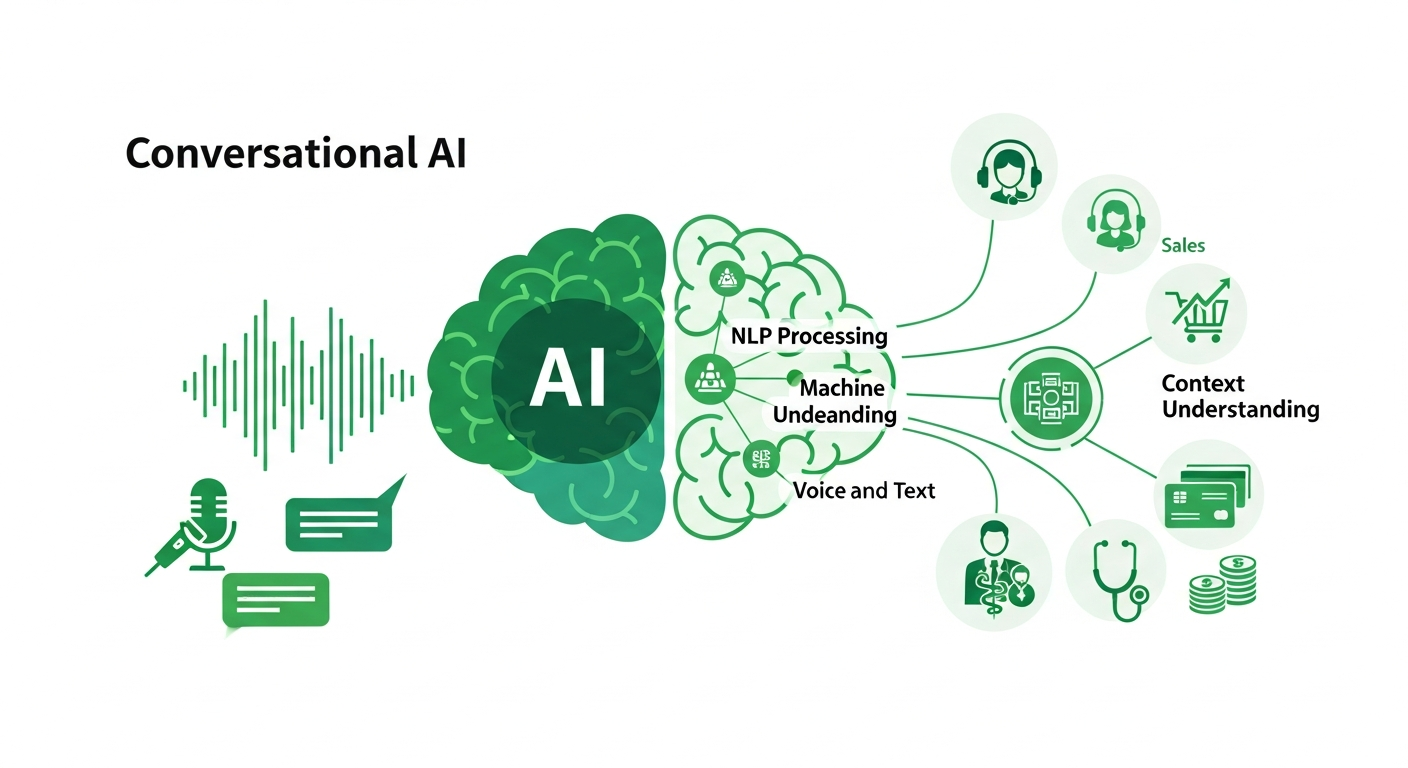
Customers no longer want to wait. They expect instant answers, personalized interactions, and seamless experiences—whether they are browsing a website, messaging on WhatsApp, or contacting customer support at midnight.
Traditional chatbots and manual support teams struggle to keep up with these expectations.
This is where conversational AI comes in.
Conversational AI allows businesses to communicate with customers in natural, human-like conversations—at scale. It goes beyond simple scripted chatbots, enabling smarter engagement across sales, marketing, customer service, and even internal operations.
In this article, you’ll learn:
What conversational AI really is
How conversational AI works behind the scenes
The difference between chatbots and conversational AI
Real conversational AI use cases across business functions
What Is Conversational AI?
Conversational AI is a branch of artificial intelligence that enables machines to understand, process, and respond to human language in a natural and contextual way.
Unlike basic chatbots that rely on predefined rules or keywords, conversational AI systems can:
Understand user intent and context
Respond dynamically, not just with scripted answers
Learn from interactions over time
Handle multi-turn, complex conversations
Conversational AI typically powers:
AI chatbots on websites and apps
Messaging assistants on WhatsApp, Messenger, Zalo, Telegram
Voice assistants and virtual agents
The goal of conversational AI is simple: make interactions feel human, helpful, and efficient.
How Conversational AI Works (Simple Explanation)

Although conversational AI feels simple to users, it relies on several advanced technologies working together.
1. User Input
The conversation starts when a user types or speaks a message (for example: “I want to book a demo”).
2. Natural Language Understanding (NLU)
The AI analyzes the message to understand:
Intent (what the user wants)
Context (what has already been discussed)
Entities (names, dates, products, locations)
3. AI Decision Engine
Based on training data, rules, and AI models, the system decides the best next action:
Answer a question
Ask a follow-up
Collect lead information
Route to a human agent
4. Response Generation
The AI generates a relevant, human-like response—often enhanced with buttons, links, or forms.
5. Learning & Optimization
Each interaction improves future responses through machine learning and feedback loops.
This is what allows conversational AI to continuously improve over time.
Conversational AI vs Traditional Chatbots
Many people confuse conversational AI with chatbots—but they are not the same.
Aspect | Conversational AI | Traditional Chatbot |
|---|---|---|
Understanding | Context & intent-aware | Keyword-based |
Responses | Dynamic, natural | Scripted |
Learning | Continuous improvement | No learning |
Conversation | Multi-turn, complex | One-step replies |
Use cases | Sales, CX, ops | FAQs only |
In short: all conversational AI can be chatbots, but not all chatbots are conversational AI.
This difference becomes critical as businesses scale and customer expectations rise.
Real Conversational AI Use Cases in Business

Below are the most common and high-impact conversational AI use cases across industries.
1️⃣ Conversational AI in Sales & Lead Generation
Conversational AI is increasingly used as a digital sales assistant.
Key use cases:
Engage website visitors instantly
Qualify leads by asking smart questions
Book meetings or demos automatically
Recommend products or services
Instead of static forms, conversational AI creates interactive experiences that increase conversion rates and reduce lead drop-off.
2️⃣ Conversational AI in Customer Support (CSKH)
Customer support is one of the most mature conversational AI use cases.
Key use cases:
Answer FAQs 24/7
Handle order status, billing, and account questions
Reduce ticket volume for human agents
Seamlessly hand off complex cases to humans
Conversational AI improves response time while lowering operational costs—without sacrificing customer experience.
3️⃣ Conversational AI in Marketing & Engagement
Conversational AI helps marketers turn campaigns into conversations.
Key use cases:
Engage users from ads or landing pages
Personalized follow-ups via chat or messaging apps
Lead nurturing across multiple channels
Event registration and onboarding flows
This turns one-way marketing into two-way engagement.
4️⃣ Conversational AI in HR & Internal Operations
Beyond customer-facing roles, conversational AI is increasingly used internally.
Key use cases:
HR onboarding assistants
Internal knowledge base bots
Employee self-service (leave, policies, FAQs)
Training and learning assistants
This reduces repetitive internal requests and improves employee productivity.
Conversational AI Examples in Real Platforms
Modern businesses rarely deploy conversational AI in isolation. Instead, they use full platforms that combine AI, automation, and integrations.
For example, InCard enables conversational AI across:
Sales & lead generation chatbots
Customer support automation
Multi-channel messaging (website, WhatsApp, Messenger, Zalo)
AI agents trained on business data
This platform-based approach allows businesses to manage conversations across the entire customer journey—not just isolated chats.
Benefits of Conversational AI for Businesses
Implementing conversational AI delivers measurable benefits:
24/7 availability without increasing headcount
Higher engagement and conversion rates
Lower customer acquisition and support costs
Consistent, on-brand communication
Actionable data and insights from conversations
For growing businesses, conversational AI becomes a competitive advantage—not just a tool.
When Does a Business Need Conversational AI?
Conversational AI is especially valuable when:
You receive high volumes of repetitive inquiries
Leads drop off due to slow response times
Sales teams are overloaded with low-quality leads
Customer experience consistency is a challenge
You want to scale without linear cost growth
At this stage, basic chatbots are no longer enough.
What’s Next? From Conversational AI to Conversational AI Platforms
Conversational AI is powerful—but its real impact is unlocked when combined with automation, CRM, analytics, and AI agents.
That’s where Conversational AI Platforms come in.
Conclusion
Conversational AI is redefining how businesses communicate—with customers and internally. By enabling natural, scalable, and intelligent conversations, it transforms sales, support, marketing, and operations.
If your goal is to improve engagement, efficiency, and growth, understanding conversational AI is the first step toward building smarter, more connected experiences.