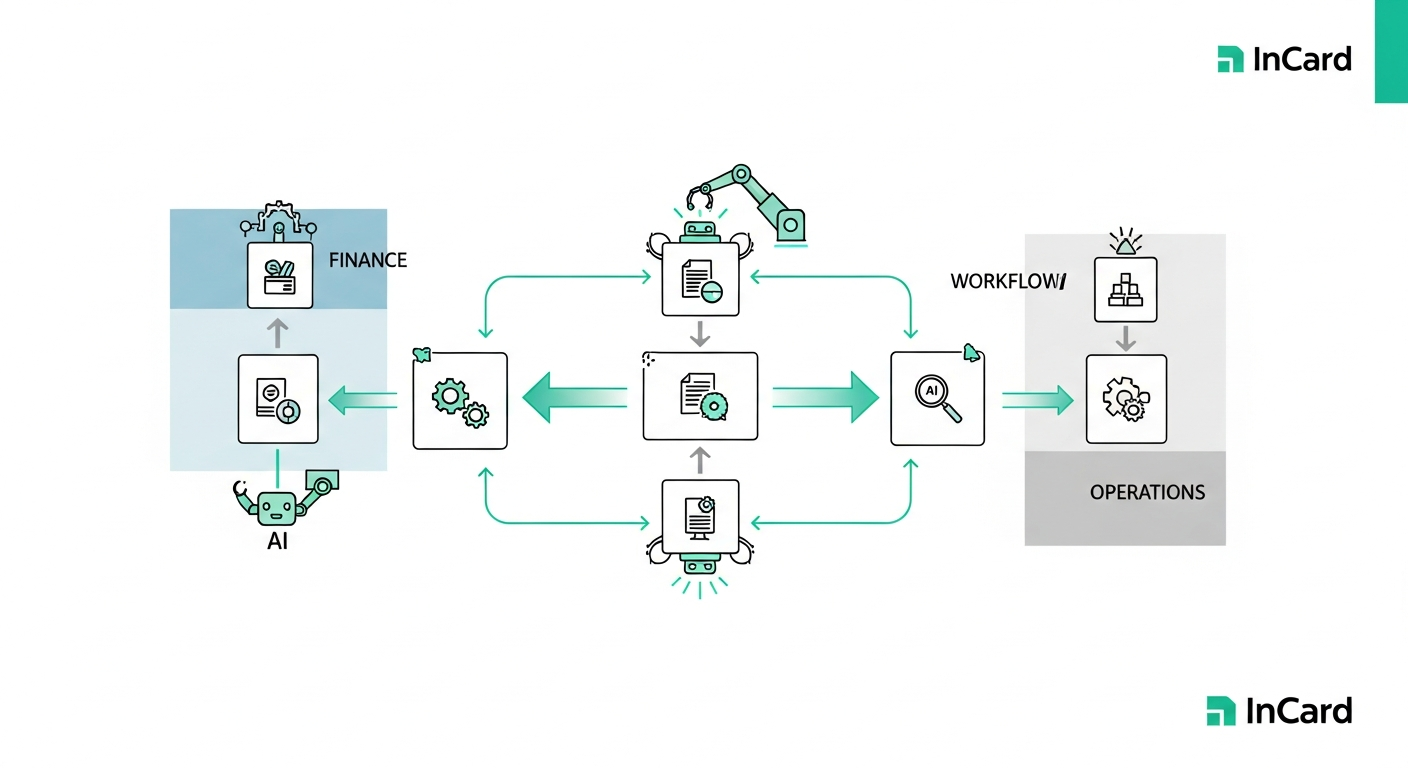
Every business runs on workflows, the sequences of tasks, handoffs, decisions, and communications that turn effort into outcomes. And in most organizations, a significant portion of those workflows are still driven by manual effort: copying data between systems, sending follow-up emails, updating spreadsheets, routing approvals, and chasing status updates. This is not just inefficient. It is a direct drag on growth.
Workflow automation with AI changes the equation. By combining the rule-based reliability of traditional automation with the adaptive intelligence of artificial intelligence, modern AI-powered workflow tools can handle not just structured, predictable tasks but also the nuanced, context-dependent work that legacy automation could never touch.
Whether you are a startup trying to do more with a lean team, a mid-market company looking to scale without proportional headcount growth, or an enterprise organization seeking to reduce operational complexity, AI workflow automation offers a practical, high-ROI path forward. This guide covers how it works, where it delivers the most value, which platforms are leading the space, and how to build a successful implementation strategy.
What Is Workflow Automation with AI?
Workflow automation with AI refers to the use of artificial intelligence technologies including machine learning, natural language processing, computer vision, and large language models to automate business processes that involve decision-making, pattern recognition, unstructured data, and adaptive logic.
Traditional workflow automation, such as robotic process automation (RPA) and rule-based tools, excels at tasks that are repetitive, structured, and clearly defined: moving data from point A to point B, triggering an action when a condition is met, filling out a form with known inputs. These tools are valuable, but brittle any variation in input or process can break them.
AI-powered workflow automation is fundamentally different. It can read and classify unstructured documents, understand the intent behind a customer email, make routing decisions based on context, summarize meeting notes and extract action items, generate first-draft communications, and continuously improve its accuracy as it processes more data. The result is automation that handles the messy, real-world complexity of how businesses actually operate not just idealized process flows.
Key Components of an AI Workflow Automation System
Effective AI workflow automation is rarely a single tool it is an architecture of complementary capabilities working together. Understanding the core components helps businesses build systems that are both powerful and maintainable:
Intelligent Triggers and Adaptive Conditions
Traditional automation triggers are binary: if X happens, do Y. AI-powered triggers are contextual: if X happens and the context suggests Z, choose from options Y1, Y2, or Y3. This adaptive logic allows workflows to respond intelligently to variation routing a high-value customer complaint differently from a routine inquiry, or escalating an approval request based on dollar amount and risk signals rather than a fixed threshold.
Natural Language Processing and Document Intelligence
A significant share of business data arrives as unstructured text: emails, contracts, invoices, support tickets, meeting transcripts, and forms. NLP-powered workflow automation can read, classify, extract key information from, and act on this content at scale. Document intelligence tools go further using computer vision and AI to process scanned documents, PDFs, and images with the same accuracy as structured digital inputs.
AI Decision Engines and Predictive Routing
At the heart of intelligent workflow automation is the ability to make decisions not just execute them. AI decision engines evaluate incoming data against learned patterns and business rules to determine the optimal next action. In sales workflows, this might mean scoring a lead and routing it to the right rep. In finance, it might mean flagging an invoice for review based on anomaly detection. In HR, it might mean prioritizing applications that match a defined candidate profile.
Generative AI for Content and Communication Workflows
Large language models have added a powerful new dimension to workflow automation: the ability to generate high-quality written content as part of an automated process. This includes drafting personalized outreach emails, summarizing documents for review, generating meeting notes from transcripts, producing first drafts of reports, and creating customer-facing responses. Generative AI in workflows reduces the time humans spend on content creation while maintaining quality and consistency.
Cross-System Integration and Process Orchestration
AI workflow automation delivers its full value only when it can move data and trigger actions across the systems a business relies on CRM, ERP, HRIS, marketing automation, helpdesk, communication tools, and cloud storage. Modern platforms provide pre-built connectors and API frameworks that make this orchestration possible without extensive custom development, enabling end-to-end workflows that span departmental and system boundaries.
High-Value Use Cases for AI Workflow Automation
AI workflow automation is being applied across virtually every business function. These are the areas where it consistently delivers the highest return:
Sales and Revenue Operations
In sales, manual workflows are one of the primary reasons deals stall and revenue leaks. AI automation addresses the most common bottlenecks: leads that are not followed up quickly, CRM records that are out of date, sequences that are not personalized, and pipeline stages that are not progressed because reps are buried in admin. With AI, lead enrichment happens automatically, follow-up sequences trigger based on behavior, and pipeline hygiene is maintained without requiring manual data entry.
Marketing Campaign and Content Workflows
AI transforms marketing workflows by enabling personalization at a scale that human effort cannot match. Dynamic content generation, audience segmentation based on behavioral signals, automated A/B testing with AI-driven optimization, and multi-channel campaign orchestration are all becoming standard capabilities. Content workflows benefit particularly from generative AI, which can produce first drafts, repurpose content across formats, and adapt messaging for different audience segments.
Finance, Invoicing, and Procurement
Finance teams are among the biggest beneficiaries of AI workflow automation. Invoice processing extracting data from supplier invoices, matching against purchase orders, flagging discrepancies, and routing for approval is a high-volume, rule-bound process that AI handles with exceptional accuracy and speed. Expense management, financial close checklists, and audit preparation workflows are equally well-suited to AI-powered automation, reducing both processing time and error rates.
HR, Recruiting, and People Operations
From resume screening and interview scheduling to onboarding checklist automation and employee offboarding, HR workflows are rich with repetitive, structured tasks that AI handles efficiently. AI can also support more nuanced processes analyzing employee survey sentiment, identifying patterns in attrition data, or personalizing learning and development recommendations adding an intelligent layer to people operations beyond simple task automation.
Customer Success and Support Operations
AI workflow automation in customer success encompasses ticket routing, escalation logic, proactive health score monitoring, renewal workflow management, and onboarding sequence automation. By connecting CRM data, product usage signals, and support history, AI can trigger the right intervention at the right moment whether that's a check-in call, a resource recommendation, or a renewal discount offer without requiring customer success managers to monitor dashboards manually.
Leading AI Workflow Automation Platforms
The market for AI workflow automation tools has expanded significantly, with platforms serving everything from no-code business users to developer-heavy engineering teams. Here is how the leading options compare:
Zapier and Make (Formerly Integromat)
Zapier and Make are the dominant no-code/low-code automation platforms, enabling businesses to connect thousands of apps and automate workflows without engineering resources. Both have integrated AI capabilities including OpenAI and Claude integrations that allow users to add generative AI steps into automations. They excel at connecting best-of-breed SaaS tools and are the fastest way to automate straightforward cross-system workflows.
Microsoft Power Automate and Copilot
For organizations running on the Microsoft 365 ecosystem, Power Automate provides deep integration with Teams, SharePoint, Outlook, Dynamics, and Azure. Microsoft Copilot layers AI assistance across these workflows, enabling natural language workflow creation, AI-powered document processing, and intelligent automation suggestions. Power Automate is particularly strong for enterprise environments with complex approval chains and compliance requirements.
InCard: AI-Powered Workflow Automation Built Around Relationships
InCard (incard.biz) takes a distinctly human-centered approach to AI workflow automation. While most automation platforms focus on connecting systems and moving data, InCard is built around the insight that the most valuable business workflows are those that strengthen relationships with customers, prospects, and partners.
InCard's AI layer automates the relationship workflows that typically fall through the cracks: follow-up sequences that feel personal rather than templated, timely nudges based on relationship health signals, intelligent reminders triggered by contact behavior and engagement history, and automated context-gathering before key meetings. For sales teams, account managers, and business development professionals, InCard removes the cognitive load of relationship management ensuring that the right person hears from you at the right time, with the right message, without requiring manual tracking or calendar reminders.
What sets InCard apart in the workflow automation landscape is its focus on outcome quality, not just task completion. Automating a follow-up email is easy automating a follow-up that feels genuinely attentive and relevant is hard. InCard's AI is trained to close that gap, making it a natural fit for businesses where relationship quality is a competitive advantage.
UiPath and Automation Anywhere
UiPath and Automation Anywhere are enterprise RPA leaders that have incorporated AI and machine learning to create what they call intelligent automation or hyperautomation. Both platforms combine traditional RPA bots with AI-powered document processing, process mining, and decision management making them well-suited for large organizations with complex, high-volume back-office operations that require both structured and unstructured data handling.
Building Your AI Workflow Automation Strategy
A successful AI workflow automation initiative requires more than choosing the right tool. It demands a thoughtful strategy that aligns technology investment with business priorities. Here is a practical framework for getting started:
Step 1: Audit and Map Your Current Workflows
Before automating anything, document how your highest-impact workflows actually operate today not how they are supposed to operate, but how they really work. Process mining tools can help surface the actual paths tasks take through your systems, revealing bottlenecks, redundant steps, and variation points that are invisible on a process map. This audit becomes the foundation for prioritization.
Step 2: Prioritize by Impact and Automation Feasibility
Not every workflow is equally worth automating. Prioritize candidates that combine high impact with high automation feasibility. Strong candidates share these characteristics:
High volume: the task is performed frequently, making time savings significant
Rule-bound: the logic of the task is clear enough to define, even if it requires AI to handle variation
Data-rich: the workflow generates or consumes structured data that can be analyzed and acted upon
Error-prone: the manual version has a meaningful error rate that automation would reduce
Time-sensitive: delays in execution have a measurable business cost
Step 3: Start with Focused Pilots, Not Big Bangs
The most common mistake in automation initiatives is attempting too much too quickly. Begin with two or three high-priority workflows, implement them thoroughly, measure the results rigorously, and use those results to build the business case for expansion. Pilots that demonstrate clear ROI create organizational momentum and stakeholder confidence that broad rollouts cannot.
Step 4: Build for Maintainability from Day One
Automated workflows break when the systems they depend on change. Design your automations with maintenance in mind: document every workflow, use modular components that can be updated independently, build monitoring and alerting into every process, and assign clear ownership for each automated workflow. The automation that runs invisibly for two years and then silently fails is worse than one that was never built.
Measuring the ROI of AI Workflow Automation
Demonstrating the value of AI workflow automation requires tracking the right metrics at the right level of granularity. Broad claims about efficiency gains are less persuasive than specific, workflow-level data. Key metrics to track include:
Time saved per workflow: the reduction in human hours required to complete the process end to end
Error rate reduction: the decrease in mistakes, exceptions, and rework caused by manual handling
Cycle time improvement: how much faster the workflow completes from trigger to outcome
Cost per transaction: the reduction in fully-loaded cost to execute a unit of work
Employee time reallocation: how the hours freed by automation are being reinvested in higher-value work
Business outcome impact: the downstream effect on revenue, customer satisfaction, or operational KPIs most directly influenced by the automated workflow
According to McKinsey's research on automation, organizations that approach workflow automation strategically with clear measurement frameworks and iterative improvement cycles realize two to four times the value of those that deploy automation tactically without a coherent strategy. The measurement discipline is not optional; it is what transforms a collection of automations into a genuine competitive capability.
The Future of Workflow Automation with AI
The capabilities of AI workflow automation are evolving faster than most organizations can absorb. Several trends are set to define the next generation of intelligent automation:
Agentic AI: autonomous AI agents that can plan and execute multi-step workflows end to end, adapting in real time to changing conditions without requiring a human to define every decision point in advance
Process mining and auto-discovery: AI that analyzes system logs and user behavior to automatically identify automation opportunities, recommend workflow designs, and even build the automations itself
Human-AI collaborative workflows: systems designed not to replace humans but to augment them handling the structured, repetitive elements while surfacing context and recommendations for the judgment-intensive decisions that require human expertise
Real-time workflow intelligence: dashboards and monitoring systems that use AI to detect workflow anomalies, predict bottlenecks before they occur, and recommend process improvements continuously
Cross-organizational automation: AI-powered workflows that span organizational boundaries connecting a business's systems with those of its suppliers, partners, and customers to automate end-to-end processes that currently require significant manual coordination
Conclusion: Automate the Work, Amplify the Value
Workflow automation with AI is one of the highest-leverage investments a business can make. It compounds over time each workflow automated frees human capacity for more valuable work, generates data that makes the AI smarter, and builds organizational confidence that accelerates future adoption.
The businesses winning with AI automation today are not necessarily the ones with the biggest technology budgets. They are the ones that have been most deliberate about where they focus: starting with the workflows that matter most, measuring impact rigorously, and building a culture of continuous improvement around automation as a strategic capability.
Whether you deploy enterprise-scale intelligent automation through UiPath or Power Automate, connect your SaaS stack with Zapier or Make, or use relationship-intelligence-driven workflow automation through InCard (incard.biz) to ensure no follow-up, no check-in, and no key relationship moment is ever missed the right starting point is the same: identify your highest-cost manual processes and automate them first.
The technology is ready. The ROI is proven. The question is no longer whether to automate it is how fast you can move without sacrificing the quality and intentionality that make automation genuinely valuable.