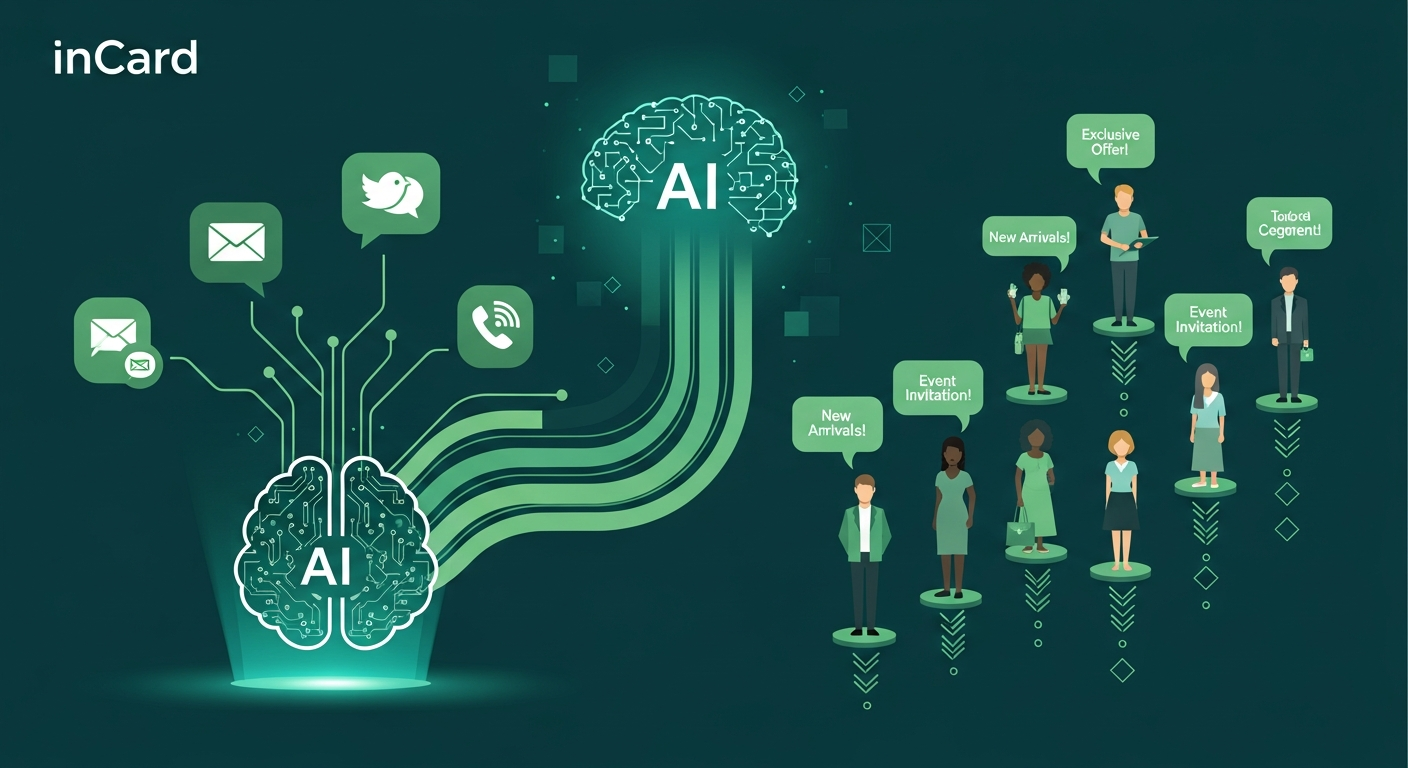
Personalized marketing with AI is no longer an experimental initiative owned by a single team. It is rapidly becoming a core operating model for growth—especially for SMEs and professional service businesses that must compete with lean budgets, fragmented channels, and rising customer expectations.
Two signals stand out. First, generative AI adoption is accelerating: the St. Louis Fed’s Real-Time Population Survey reported overall genAI adoption among U.S. adults (18–64) rising to 54.6% in August 2025 (up ~10 percentage points year-over-year), showing how quickly AI habits are becoming mainstream. Second, customers increasingly judge brands by relevance, not reach—yet the trust bar is higher: Salesforce research notes that only 42% of customers trust businesses to use AI ethically (down from 58% in 2023), making governance and transparency a board-level requirement, not a legal footnote.
This article provides a practical, ROI-oriented InCard playbook for marketers who want to implement AI-driven personalization and marketing automation with AI—without turning their stack into a costly science project.
1) Why AI-driven personalization is now a growth requirement
Personalization is not just “dynamic name insertion” or segment-based email. At scale, it becomes a system that continuously turns first-party signals (behaviors, conversations, purchases, and intent) into the next best message, channel, and offer—automatically.
For executives, the business case is increasingly measurable:
Personalization leaders outperform laggards. BCG reports that revenue growth of retail personalization leaders is 10 percentage points higher than that of companies lagging in personalization.
Personalized offers can significantly outperform mass promotions. BCG observes returns on personalized offers can be up to 3× higher than mass promotions, while many companies still underinvest in personalization.
Vietnam is ready—but still maturing. MMA Global and Decision Lab found that while many Vietnamese organizations report medium/high AI integration, only 13% were “fully integrated”, with a large share still experimenting or partially integrated—suggesting a major competitive gap for early movers.
The implication: AI-powered personalization is becoming the default expectation, but execution quality determines whether you earn growth—or amplify churn and distrust.
2) The InCard personalization maturity model (from “content” to “customer system”)
Many teams start AI with content generation and stop there. InCard’s approach treats content as one component in a larger customer system. Use this maturity model to align stakeholders and investment.
Level 1: Assisted creation (speed)
Goal: increase throughput without lowering brand quality.
Use AI to draft social captions, landing page variants, outreach scripts, FAQs.
Standardize brand voice, compliance rules, and review steps.
Level 2: Rule-based personalization (consistency)
Goal: reliably tailor messaging by segment and lifecycle stage.
Segment by industry, job role, funnel stage, location, product interest.
Deploy templates with controlled variables (offer, pain point, proof point, CTA).
Level 3: AI-driven personalization (relevance)
Goal: use behavior + intent to automate “next best message” decisions.
Predict intent and route leads to the best channel (DM vs email vs call).
Generate individualized content variants tied to real customer signals.
Level 4: Agentic automation (ROI at scale)
Goal: connect personalization across marketing, sales, and customer success.
Run multi-step journeys, follow-ups, and reactivation loops.
Close the loop from content → conversation → conversion → retention.
InCard’s unified platform architecture is designed to help SMEs move beyond “AI tools” and into repeatable revenue operations—especially where teams must coordinate across social, direct messaging, and CRM.
3) The data foundation: first-party signals, clean consent, measurable identity
AI-driven personalization fails more often due to data issues than model issues. Your objective is not “more data,” but actionable first-party data with clear consent and consistent identity across touchpoints.
What to capture (minimum viable signal set)
Profile data: industry, role, company size, location, language preference.
Behavior: page views, clicks, form submissions, video watch, webinar attendance.
Conversation data: DM replies, objections, questions, meeting outcomes.
Commercial data: pipeline stage, deal size band, product interest, renewal date.
How InCard helps operationalize identity
Smart Networking App captures networking interactions via NFC/QR, enabling cleaner contact creation and relationship context (who met whom, where, when, and why).
Personal Relationship Management supports structured notes and follow-ups—critical for personalization that feels human, not automated.
Risk and trust by design (non-negotiable)
Trust is a measurable growth constraint. Salesforce reported only 42% of customers trust businesses to use AI ethically, which means personalization strategies must explicitly include privacy, security, and transparency controls.
Practical safeguards:
Consent-based personalization: clearly disclose what data is used and why.
Minimize sensitive data: avoid unnecessary collection; use role-based access.
Human-in-the-loop for high-risk outputs: pricing, legal/medical claims, regulated industries.
4) The InCard playbook: 6 steps to launch personalized marketing with AI
Below is a pragmatic rollout plan that fits most SMEs, marketing teams, and B2B service providers—designed to deliver measurable ROI within 4–12 weeks.
Step 1: Choose 1 use case with a clear P&L outcome
Pick a use case where personalization affects revenue quickly:
Lead-to-meeting conversion via personalized DM follow-ups
Abandoned lead recovery with tailored objection-handling content
Upsell/cross-sell based on usage signals or lifecycle milestones
In banking, CGI advises starting with a targeted proof of concept and iterating; they cite a challenger bank scaling from 11,000 to 600,000 customers using AI-driven personalization. While your market may differ, the operating principle applies: narrow scope first, then scale with evidence.
Step 2: Build the “message library” (structured, not random)
Create modular building blocks:
Pain points by industry
Proof points (case snippets, metrics, testimonials)
Offer components (trial, audit, consultation, demo)
CTA options (book a call, reply with 1–2, download, join webinar)
InCard AI marketing workflows can assemble these blocks into variants optimized for channel constraints (short-form social vs DM vs long-form email).
Step 3: Define personalization rules + AI decisions (hybrid control)
High-performing teams don’t “let AI decide everything.” They combine rules (governance) with AI (adaptation).
Rules: language, tone, excluded claims, required disclaimers, brand vocabulary.
AI decisions: which angle to emphasize, which proof point to surface, what follow-up question to ask.
Step 4: Orchestrate the journey across social + direct messaging
SMEs in Vietnam often win through fast conversations—especially on social platforms and messaging. Your AI-driven personalization should therefore connect top-of-funnel content to a bottom-of-funnel dialogue path.
Social Media Suite: publish and test multiple creative angles by persona.
Direct Messaging: trigger tailored follow-ups based on engagement (comment, click, inbox reply).
Content Creator: generate localized variants fast while maintaining brand consistency.
Step 5: Measure the right KPIs (focus on revenue math)
Personalization must be measured beyond vanity engagement. Use an executive dashboard with:
Pipeline KPIs: meeting rate, SQL rate, win rate, sales cycle length
Efficiency KPIs: cost per meeting, cost per SQL, time-to-first-response
Retention KPIs: renewal rate, expansion rate, churn reasons
BCG’s findings—like returns on personalized offers being up to 3× higher than mass promotions—underline why teams should track incremental lift, not just activity volume.
Step 6: Scale what works, then invest in training
Vietnamese marketers identify skill gaps as a major challenge. MMA/Decision Lab data highlights struggles with tool selection, prompting, and training requirements. Plan enablement as part of your rollout:
Prompt playbooks per channel (social, DM, landing pages)
Quality gates and approval workflows
Monthly “test-and-learn” review with documented learnings
5) Practical examples: AI personalization patterns that work for SMEs
Below are field-tested personalization patterns that tend to outperform generic automation—especially for Vietnam-based SMEs operating in fast-moving categories like services, education, real estate, and B2B SaaS.
Pattern A: “Persona-first” DM sequences (marketing automation with AI)
Trigger: user clicks a service page or engages with a post.
AI personalization: tailor the opener to role + pain point + local context.
Outcome KPI: reply rate → meeting rate.
Pattern B: Next-best content recommendation (AI-driven personalization)
Trigger: user consumes content on Topic A (e.g., “sales scripts”).
AI personalization: recommend Topic B (e.g., “objection handling”) with a short summary and CTA.
Outcome KPI: content-to-lead conversion.
Pattern C: Networking-to-pipeline personalization (InCard advantage)
This is where InCard differentiates: combining networking identity with automated follow-up.
Trigger: new contact created via NFC/QR business card exchange.
AI personalization: follow-up message referencing meeting context + a relevant asset.
Outcome KPI: time-to-follow-up, meeting booked within 7 days.
Conclusion: A board-ready roadmap to automate, connect, and grow
Personalized marketing with AI is now a competitive requirement, but winning requires more than content generation. Marketers must build a system: first-party data, consent-based identity, cross-channel orchestration, and executive-grade measurement.
InCard’s unified Agentic AI Platform and Smart Networking App are designed to help SMEs operationalize this system—turning personalization into a repeatable growth engine across marketing, sales, and customer success.
If you are ready to launch an ROI-focused pilot, start with one journey (social → DM → meeting) and define success metrics upfront. InCard can help your team Automate. Connect. Grow.