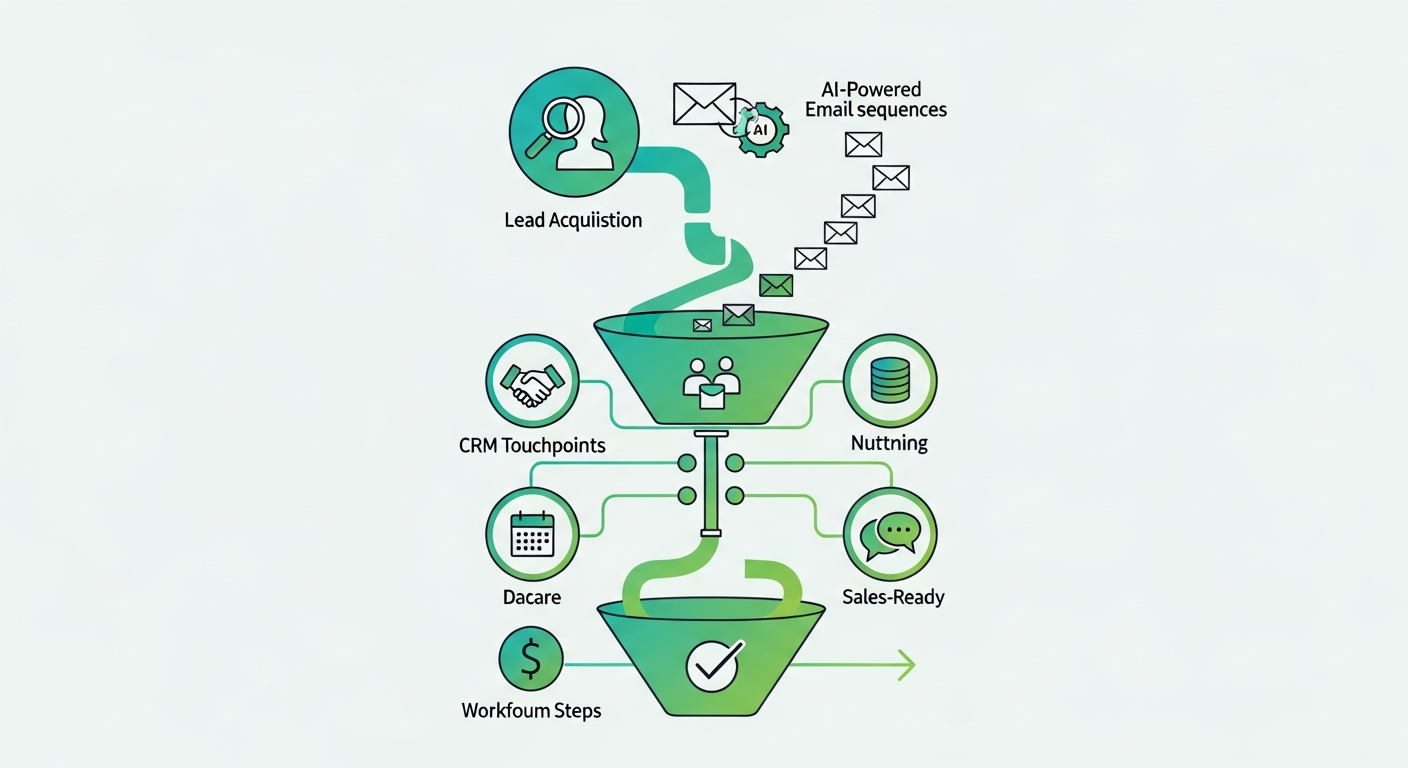
In B2B, the hardest part of growth is rarely “getting more leads.” It is turning early interest into revenue-ready conversations without inflating headcount, drowning Sales in low-intent inquiries, or losing prospects to faster competitors. That is precisely where lead nurturing automation becomes a strategic advantage: it operationalizes consistent follow-up, uses behavioral signals to prioritize outreach, and creates measurable handoffs between Marketing and Sales.
Buyer behavior continues to shift toward digital-first exploration, but not in a “fully self-serve” way. Gartner reports that 75% of B2B buyers prefer a rep-free sales experience, yet purely self-service digital purchases are more likely to produce purchase regret; rep-assisted digital paths reduce regret and improve deal quality. This reality calls for hybrid workflows: automation does the heavy lifting (education, reminders, qualification), while Sales steps in at the moments that matter.
1) What “sales-ready” actually means (and why definitions fail)
Many teams try to fix lead quality by changing form fields or adding more “gating.” The more sustainable approach is to agree on a shared definition of a sales-ready lead and then encode it into marketing automation workflows.
Sales-ready should be defined by a combination of:
Fit (ICP match): industry, company size, role, region, budget range.
Intent (behavior): pages visited, product actions, replies, time on key content, demo/pricing views.
Readiness (timing): buying window, active project signals, internal urgency, stakeholder involvement.
Gartner’s buyer research also highlights complexity: typical buying groups involve five to 11 stakeholders across multiple functions, and organizational change is a major driver of B2B purchases. A “sales-ready” workflow must therefore account for multiple roles and multiple steps, not just one person downloading one asset.
Practical output: a Sales-Ready SLA
Before you automate, document an SLA that states:
What score/criteria triggers Sales outreach
Expected response time (e.g., within 15 minutes for high-intent inbound)
What happens when Sales does not reach the lead (recycle rules)
What feedback Sales must provide (reason codes to improve scoring)
2) The workflow blueprint: from capture to qualification to handoff
High-performing lead qualification automation is not a single journey. It is a system of connected micro-workflows that cover the entire lifecycle:
Capture workflow: normalize data, deduplicate, enrich firmographics, source tagging.
Activation workflow: deliver the “first value” fast (welcome + next-step), route by persona.
Nurture workflow: education + proof + risk reduction across multiple touches.
Conversion workflow: high-intent triggers (pricing, demo, reply) → fast Sales motion.
Recycling workflow: if not ready, re-nurture based on reason codes and interest category.
Why does this matter for executives? Because each workflow creates operational leverage. Nucleus Research found that marketing automation can drive a 14.5% increase in sales productivity and a 12.2% reduction in marketing overhead. Those outcomes come from designing workflows that scale without losing relevance.
Core design rule: automate the “repeatable,” humanize the “decisive”
Automation should handle tasks that are frequent and predictable: follow-ups, reminders, content delivery, segmentation updates, and status changes. Human sellers should focus on decisive moments: discovery, complex objections, stakeholder alignment, and final negotiation—exactly the hybrid approach Gartner recommends for better-quality outcomes.
3) Lead scoring that works: beyond arbitrary points
Lead scoring is often implemented as a simple point system and then ignored. Effective scoring has three characteristics:
Transparent: Sales can understand why a lead is “hot.”
Adaptive: thresholds change by segment, channel, and sales motion.
Validated: scores correlate with outcomes (SQL rate, win rate, sales cycle length).
Recommended scoring model: Fit + Intent + Negative signals
Use two positive dimensions plus one risk dimension:
Fit score (0–100): ICP match—role seniority, company size, industry priority, location, tech stack.
Intent score (0–100): behaviors—pricing page visits, demo requests, comparison pages, reply/DM engagement.
Negative score (-0 to -100): student emails, competitors, job seekers, repeated bounces, unsubscribes.
Then create a routing matrix instead of a single threshold:
High Fit + High Intent → immediate Sales outreach + short “conversion” sequence
High Fit + Low Intent → longer educational drip campaigns
Low Fit + High Intent → partner/SMB motion, self-serve, or qualification call before assigning AE
Operational tip: score the buying group, not only the individual
Because buying involves multiple stakeholders, track account-level engagement. If three people from the same company interact with product/ROI content in a week, that is often more predictive than one person downloading a checklist. This is where modern “agentic” marketing trends—using AI to coordinate signals and decisions—are heading. Salesforce’s State of Marketing notes that marketers are moving toward personalized, two-way engagement, while many remain dissatisfied with how effectively they use data; leading teams close the gap with AI.
4) Drip campaigns that do not feel like spam
Drip campaigns are not about sending more emails; they are about sending the right progression of value, proof, and reassurance. The most common failure mode is building a linear sequence that ignores engagement signals.
A modern drip framework: 3 lanes, 1 exit
Lane A: Education (problem framing): guides, templates, short videos, diagnostic quizzes.
Lane B: Proof (risk reduction): case studies, benchmarks, ROI calculators, security/trust content.
Lane C: Activation (next step): webinar, consultation, product tour, demo, trial onboarding.
Every message should include an engagement-based branch:
If clicked “pricing/ROI” → increase intent score and move to conversion workflow
If inactive for 14 days → switch channel (e.g., LinkedIn message, SMS, retargeting) or re-check persona fit
If replies with a question → route to Sales or an AI sales assistant for immediate triage
Speed matters: automation protects response-time SLAs
In fast-moving categories, a 24–48 hour delay between intent and follow-up is effectively a self-inflicted loss. Automation ensures rapid response without requiring Sales to watch dashboards all day. This is especially relevant in Vietnam’s SME market, where founders and sales owners often multitask across marketing, sales, and operations.
5) Marketing automation workflows for qualification: turning signals into decisions
Lead nurturing automation becomes “sales-ready” when it embeds qualification logic—without turning the buyer journey into an interrogation. Use progressive profiling and conversational qualification rather than long forms.
Qualification workflow: a proven sequence
Step 1: Confirm the context (industry/role/company size) via short form or chat.
Step 2: Detect intent via behavior: pricing, integrations, competitor comparisons, webinar attendance.
Step 3: Ask one high-signal question: “Are you evaluating solutions in the next 30–90 days?”
Step 4: Route: immediate Sales meeting, or nurture path aligned to timeframe.
When designed well, these workflows support the hybrid buying model Gartner recommends and reduce buyer regret by adding timely human help when needed.
How to measure qualification quality
MQL → SQL conversion rate (is scoring accurate?)
SQL → Opportunity rate (is Sales receiving the right leads?)
Opportunity win rate by source and nurture track
Time-to-first-touch after high-intent triggers
Recycling rate and “recycled lead” reactivation rate
6) Implementation playbook for SMEs: 30 days to a working system
For SMEs, the best plan is not “implement everything.” It is to implement a minimal set of workflows that deliver visible ROI, then expand.
Week 1: Data and lifecycle foundations
Define lifecycle stages (Lead, MQL, SQL, Opportunity, Customer)
Standardize source/UTM tracking and deduplication rules
Create 2–3 core segments (ICP A, ICP B, Non-ICP)
Week 2: Scoring and routing
Build Fit scoring from CRM fields (role, company size, industry)
Build Intent scoring from 5–7 key behaviors
Set routing rules and Sales SLA (response expectations)
Week 3: Drip campaigns (two tracks only)
Track 1: High-fit leads (education + proof)
Track 2: High-intent leads (conversion-focused)
Add branches: click pricing/ROI, request demo, reply, inactivity
Week 4: Reporting + optimization loop
Dashboard: MQL→SQL, SQL→Opp, Opp→Win, time-to-touch
Monthly scoring calibration with Sales feedback
Content improvements based on drop-off points in the journey
Over time, advanced teams incorporate AI to optimize personalization and decisioning. Salesforce’s State of Marketing highlights the industry shift toward two-way messaging and AI-enabled personalization at scale. The takeaway for leadership is not “use AI everywhere,” but “use AI where it reduces cycle time, improves relevance, and strengthens handoffs.”
Conclusion: automation is your revenue operating system
Lead nurturing automation is not a marketing tactic—it is an operating system for predictable growth. When combined with disciplined lead scoring, signal-driven drip campaigns, and measurable lead qualification automation, it aligns Marketing and Sales around a shared definition of “sales-ready” and creates a scalable, hybrid buying experience that buyers actually prefer.
If you want to operationalize these workflows quickly—without adding tools that don’t integrate—InCard’s unified Agentic AI Platform can help you design end-to-end marketing automation workflows and connect them to real sales motions. Automate follow-ups, connect channels, and grow revenue with measurable ROI—Automate. Connect. Grow.