You've invested in a chatbot. You expected improved customer experience. Instead, you're hearing complaints. Customers are frustrated. They're asking basic questions the chatbot can't answer. They're hitting dead ends and asking for human support anyway.
This is the story of most chatbot implementations. Businesses deploy chatbots with good intentions, but the technology doesn't deliver. Why? Usually because they chose the wrong type of chatbot for their needs.
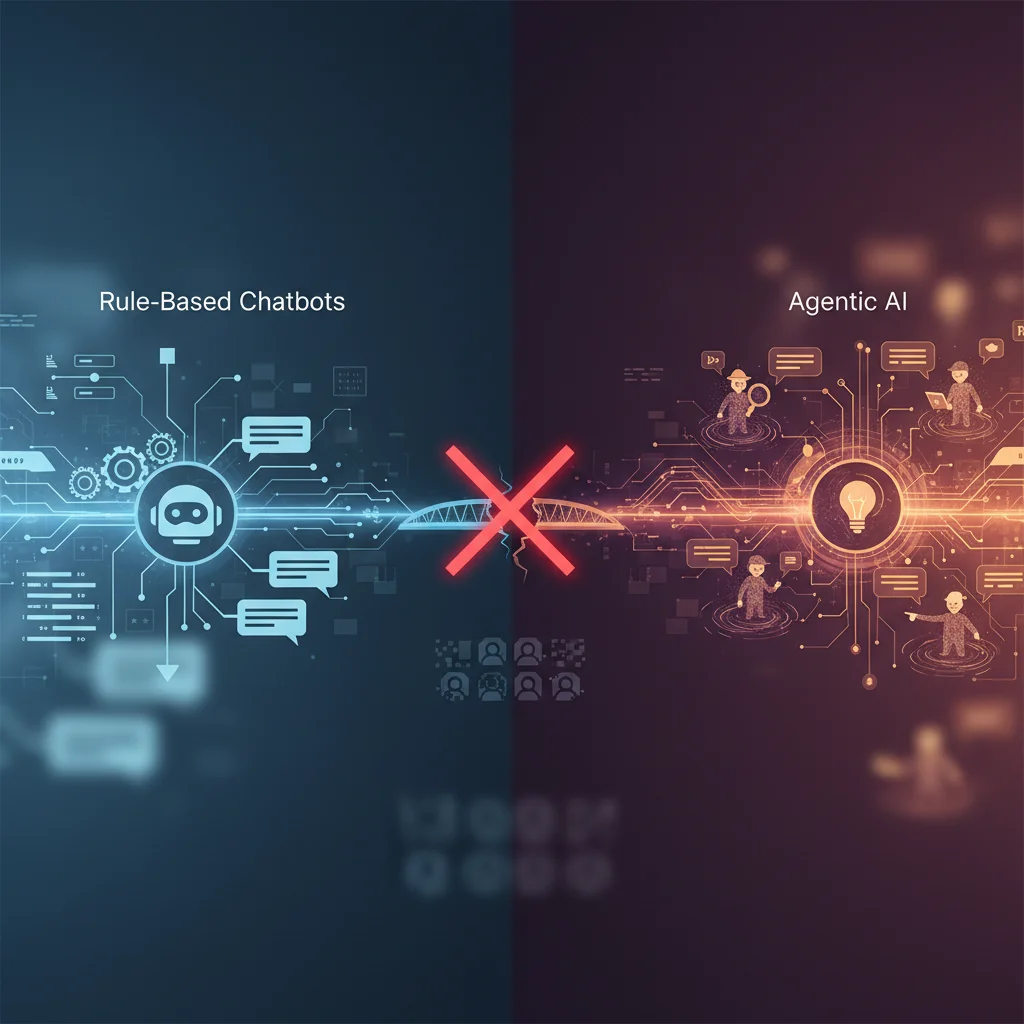
There are two fundamentally different approaches to chatbot technology: rule-based chatbots and agentic AI chatbots. Understanding the difference—and knowing which mistakes each makes—is critical to successful chatbot implementation. Using the wrong type costs you in poor customer experience, wasted implementation effort, and forgone ROI.
This guide walks you through common chatbot mistakes, explains how different chatbot architectures fail in different ways, and helps you understand when agentic AI is the right choice for your business.
The Two Types of Chatbots (And Why This Matters)
Rule-Based Chatbots: The Rigid Approach
Rule-based chatbots operate on programmed decision trees. They work like this:
IF customer says "pricing" THEN show pricing page
IF customer says "hours" THEN show business hours
IF customer says "refund" THEN show refund policy
They answer questions they've been specifically programmed to handle. Everything else they struggle with.
Agentic AI Chatbots: The Intelligent Approach
Agentic AI chatbots understand intent and context. They work like this:
Customer asks a question (phrased however they want)
AI understands the actual intent behind the question
AI determines the best response based on broader knowledge and context
AI can handle variations and unexpected questions
AI learns and improves over time
The difference matters enormously. It determines whether customers feel helped or frustrated.
Mistake #1: Deploying a Rule-Based Chatbot for Complex Use Cases
The Problem
Rule-based chatbots work great for simple, repetitive questions. But most business needs are more complex than that. When you deploy a rule-based chatbot for sophisticated customer interactions, you get frustrated customers.
How Rule-Based Chatbots Fail
A customer asks: "I bought your product three weeks ago and the widget isn't working properly when I connect it to my existing setup. What should I do?"
A rule-based chatbot might have rules for:
"How do I troubleshoot?"
"My product isn't working"
"Technical support"
But this specific question combines multiple issues. It requires understanding:
Context (bought three weeks ago, so likely past warranty question)
Specific product setup (connection to existing system)
Root cause diagnosis (is it the product or the setup?)
Appropriate next steps (could be troubleshooting, replacement, or escalation)
Rule-based chatbots don't handle this. They pattern-match to a generic response that doesn't actually help. Customer frustration ensues.
The Customer Experience Result
Customer feels unheard
Chatbot response doesn't address their specific situation
Customer escalates to human support (defeating the purpose)
Customer experience worsens, not improves
When Rule-Based Chatbots Actually Work
Rule-based chatbots are appropriate for:
Simple FAQs (hours, locations, basic policies)
High-volume, repetitive questions
Straightforward routing to departments
Single-step transactions
If your use case goes beyond this, rule-based is the wrong choice.
Mistake #2: Poor Chatbot UX Design and User Flow
The Problem
A chatbot asks questions in a confusing order. It asks for information it already has. It doesn't explain what it's doing. Users get lost and frustrated.
Even good AI chatbots fail when the UX is poor.
Common Chatbot UX Mistakes
Asking for information in the wrong order:
Bot: "What's your name?"
Customer: "I need to reset my password"
Bot: "Great! And what's your email?"
Customer: "The one you're emailing me at. Can we please just reset my password?"
A good chatbot would ask for the password reset immediately, then request qualifying information if needed.
Asking for information already available:
Customer has logged in and provided email
Chatbot still asks "What's your email address?"
Customer sees the chatbot as unable to see context
Not explaining what's happening:
Bot: "Scanning options... Analyzing requirements..."
Customer has no idea what the bot is doing or how long it will take
Overwhelming with choices:
"You can (A) reset password, (B) update billing, (C) check order status, (D) contact support, (E) report a bug"
Customers get paralyzed by choice
Lack of graceful fallback:
Customer asks something unexpected
Bot says "I don't understand" and repeats the same menu
This repeats 3+ times before human escalation
The Fix
Good chatbot UX design:
Respects conversational flow
Remembers context
Explains what it's doing
Offers relevant next steps
Gracefully handles unexpected input
Escalates appropriately when needed
This is where agentic AI excels. Because it understands context and intent, it naturally flows like a human conversation.
Mistake #3: Unrealistic Expectations About What Chatbots Can Do
The Problem
Some businesses expect chatbots to completely replace human support. They expect a chatbot to handle any question, any complexity, any customer mood. When it doesn't, they blame the technology.
In reality, the best chatbots handle 40-60% of inquiries completely, escalate the remaining 40-60% to humans, and make those human interactions more efficient.
What Chatbots Are Actually Good At
Initial engagement and qualification
FAQ and policy questions
Appointment booking
Order status checks
Problem categorization and routing
Gathering information before human escalation
What Chatbots Struggle With
Complex problem diagnosis
Nuanced emotional situations
Edge cases not in training data
Decisions that require human judgment
Complaints requiring empathy and trust
Situations needing real-time authorization
Setting Realistic Goals
Instead of "chatbot will handle 80% of inquiries," expect:
50% handled completely
30% partially handled, escalated with context
20% immediately escalated as complex
The goal isn't to replace humans. It's to:
Handle routine inquiries automatically
Gather context before human escalation
Reduce resolution time
Improve human agent efficiency
When you set realistic expectations, chatbots deliver clear ROI.
Mistake #4: Insufficient Training Data and Continuous Improvement
How This Fails
A chatbot is deployed and... it stays exactly the same. No improvement. No learning. It handles the same 50 questions it was trained on, and nothing new.
Meanwhile, customers keep asking new questions. The chatbot fails at those. Customers escalate. The cycle repeats.
The Problem with Static Chatbots
Knowledge doesn't grow
Common customer questions go unanswered
Performance plateaus
Customer frustration increases over time
ROI decreases as customers seek alternatives
The Right Approach
Continuous improvement requires:
Monitoring what customers ask
Identifying frequently unanswered questions
Adding training data for new scenarios
Testing improvements
Measuring impact on customer satisfaction and resolution rates
This is crucial regardless of chatbot type.
Even agentic AI chatbots need updates when:
New products launch
Policies change
New customer segments arrive
New types of issues emerge
The difference: Agentic AI chatbots can handle more variation and new situations more gracefully. But they still benefit from explicit training on your specific domain.
Mistake #5: Forcing Chatbots Into the Wrong Channels
The Problem
Not every communication channel is appropriate for chatbots. Forcing a chatbot into the wrong place creates a terrible user experience.
Channel-Specific Considerations
Website chat widget – Good for chatbots
Users expect interactive support
Chat interface supports natural conversation
Users can easily escalate if needed
Works well for qualification and FAQ
SMS – Problematic for chatbots
Limited character space
Slower back-and-forth feels frustrating
Mobile context requires brevity
Better for notifications than conversations
Phone – Generally poor for chatbots
Customers expect humans on phone
Voice interactions are harder to parse
Customer frustration is immediate
Escalation is jarring
Email – Limited but useful
Works for simple, straightforward responses
Doesn't work for conversation
Good for routing inquiries to right department
Fine for confirmation messages
Social media – Depends on context
Good for simple Q&A
Poor for complex issues
Brand voice matters significantly
Public responses require care
Pick channels based on customer expectations, interaction type, and context—not just availability.
Mistake #6: Poor Integration with Your Systems
The Problem
A chatbot answers a question but can't actually do anything about it. It can't check order status because it's not connected to your order system. It can't access customer history because there's no CRM integration. It becomes a lookup tool instead of a helper.
Critical Integrations
For your chatbot to actually help, it needs access to:
CRM system – Customer history, previous interactions
Knowledge base – Policies, FAQs, product information
Ticketing system – To escalate and track issues
Order management – To check status, returns, shipping
Billing system – Account information, payment history
Calendar/scheduling – For booking meetings or appointments
Without these integrations, your chatbot is just a façade. It looks helpful but can't actually resolve issues.
The Integration Challenge
Good integrations require:
API access to your systems
Real-time data synchronization
Security and permissions management
Error handling and fallback strategies
Maintenance as your systems change
This is technically complex. Many chatbot implementations skip integration work to save time—and then wonder why the chatbot doesn't help.
Mistake #7: Ignoring Conversational AI Best Practices
Common Mistakes
Sounding robotic:
"I have detected you wish to inquire about our products"
Customers immediately know they're talking to a bot and expect less
Being unhelpful about limitations:
Bot: "I don't understand"
Customer: "I just told you clearly what I need"
Better: "That's a great question. Let me connect you with someone who can help better than I can."
Not recognizing sentiment:
Customer is frustrated or angry
Bot responds with cheerful, generic responses
Frustration increases
Losing context:
Customer mentioned problem in first message
Bot asks about it again three exchanges later
Feels like bot is incompetent
Not knowing when to escalate:
Bot has failed repeatedly
Bot keeps trying the same approach
Customer is increasingly frustrated
Bot finally escalates after wasting 10 minutes
Proper conversational AI design:
Natural language
Context awareness
Sentiment recognition
Graceful escalation
Human-like interaction
Appropriate personalization
Rule-Based vs. Agentic AI: Where Each Fails and Succeeds
Aspect | Rule-Based | Agentic AI |
|---|---|---|
Simple FAQs | Excellent | Excellent |
Varied phrasing | Poor (requires separate rule for each variation) | Excellent (understands intent) |
Context awareness | Limited | Excellent |
Complex questions | Fails | Handles well |
Unexpected questions | Fails | Handles gracefully |
Setup complexity | Low | Higher |
Customization | Requires programming | Requires training data |
Scalability | Limited (rule explosion) | Excellent (learns) |
Conversational flow | Unnatural | Natural |
Cost | Lower initial | Lower long-term |
The Bottom Line: Rule-based chatbots work for simple use cases. Agentic AI works for complex, nuanced interactions where natural conversation matters.
Choosing the Right Chatbot for Your Business
Choose rule-based if:
80%+ of inquiries are repetitive FAQs
You have limited budget
You need something deployed immediately
Your use case is genuinely simple
Choose agentic AI if:
You need to handle varied customer questions
Context and conversation matter
You want one chatbot handling multiple types of inquiries
Customer experience is a priority
You want the chatbot to improve over time
In most cases, agentic AI delivers better ROI because it handles more scenarios, improves customer experience, and reduces escalation rates.
Implementing Chatbots the Right Way
Phase 1: Define Goals (Week 1-2)
What problems should your chatbot solve?
What percentage of inquiries should it handle?
How will you measure success?
What channels will it operate in?
Phase 2: Choose the Right Technology (Week 3-4)
Rule-based or agentic AI?
Which platform aligns with your goals?
What integrations do you need?
Phase 3: Proper Implementation (Month 2-3)
Build integrations with your systems
Train on your specific domain and language
Design conversational flows
Test thoroughly with real use cases
Phase 4: Launch and Optimize (Month 4+)
Monitor performance metrics
Gather customer feedback
Identify improvement opportunities
Continuously add training data
Phase 5: Ongoing Improvement (Ongoing)
Regular performance reviews
Customer satisfaction tracking
Update training as business changes
Expand to new use cases
Key Metrics for Chatbot Success
Engagement metrics:
Conversations started per day
Average conversation length
Return visitor percentage
Effectiveness metrics:
Resolution rate (% of inquiries handled completely)
Escalation rate (% requiring human intervention)
Time to resolution
Customer satisfaction score
Business impact metrics:
Cost per inquiry handled
Reduction in support team load
Improvement in first-response time
Revenue impact (leads captured, upsell opportunities)
Experience metrics:
Customer satisfaction with chatbot interaction
Perception of chatbot helpfulness
Willingness to use chatbot again
NPS impact
Track these continuously. They tell you whether your chatbot is succeeding or failing.
Conclusion
Chatbot mistakes are usually not about the technology. They're about expectations, implementation, and choosing the wrong type of chatbot for the job.
The most common mistake? Deploying a rule-based chatbot for a complex use case, then blaming "chatbots" when it fails. Rule-based chatbots have a place. But for most business needs—especially sales and customer support—agentic AI delivers dramatically better results.
The good news? When implemented properly, chatbots work. They handle routine inquiries. They escalate complex ones efficiently. They free your team to focus on what matters. And they improve customer experience.
Your action step this week: Define what your chatbot needs to do. Identify the most common customer questions. Assess whether rule-based rules will handle 80%+ of them. If not, agentic AI is your answer.
Invest in the right chatbot the first time. Your customers—and your ROI—will thank you.