Sales leaders don’t need more “AI inspiration.” They need repeatable, auditable motions that convert pipeline into revenue. That’s exactly where an AI sales assistant (and, increasingly, an AI sales chatbot) delivers: consistent messaging, faster follow-ups, tighter qualification, and better handoffs—without adding headcount.
Market signals support the shift. Salesforce reports that 81% of sales teams are either experimenting with or have fully implemented AI, and that reps spend 70% of their time on non-selling tasks—a structural inefficiency AI is designed to remove.
Meanwhile, macro investment keeps accelerating: Gartner forecasts worldwide generative AI spending will reach $644B in 2025 (+76.4% vs. 2024), indicating that “pilot mode” is giving way to enterprise-scale execution.
This article gives you 10 practical scripts & playbooks you can deploy with sales scripts AI workflows—using InCard’s approach to InCard sales automation: unify messaging, CRM context, and multi-channel execution (social, email, messaging) into a single agentic system that supports humans rather than replacing them.
1) What an AI Sales Assistant Really Does (and What It Should Not Do)
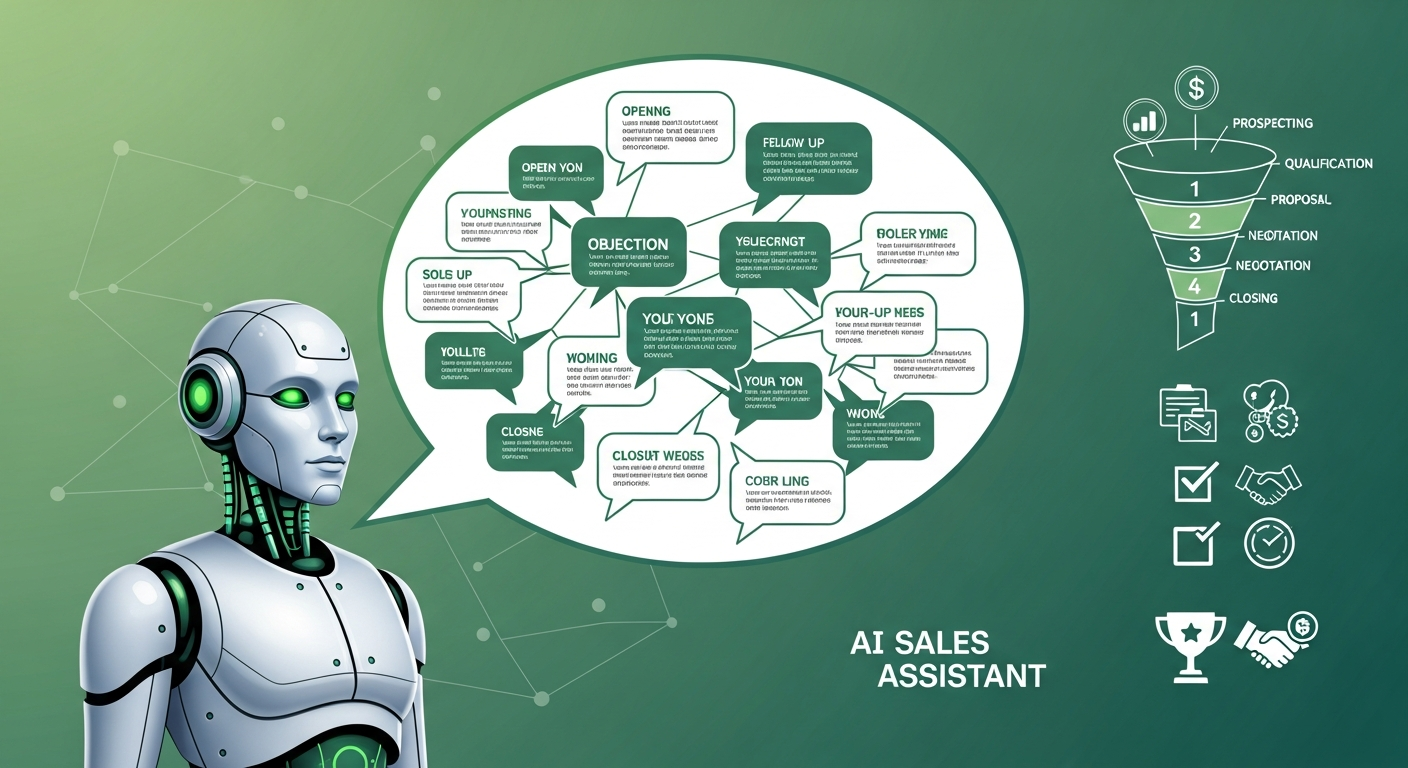
An AI sales assistant is not a generic chatbot that “answers questions.” In high-performing revenue orgs, it functions as an execution layer across the funnel:
Prospecting: build targeted lists, personalize openers, schedule outreach.
Qualification: run consistent BANT/MEDDICC-style questions, score fit.
Follow-up: recap calls, propose next steps, handle reminders and nudges.
Objection handling: respond with proof, ROI logic, and risk controls.
Closing support: mutual action plans, stakeholder mapping, procurement checklists.
What it should not do: invent facts, promise pricing/terms without approvals, or operate without governance. Gartner research has repeatedly warned that ROI and trust are often the hard part of scaling AI—leaders need controls, not just capability.
AI assistant vs. AI sales chatbot
AI sales assistant: supports sales reps internally (drafts, analysis, next-best actions).
AI sales chatbot: interacts with prospects/customers externally (web, messaging, social DMs), qualifying and routing.
In practice, top teams run a hybrid model: the chatbot handles first contact and qualification, then hands off to a rep supported by an assistant that maintains context and consistency.
2) Why These Scripts Matter Now: Adoption, ROI Pressure, and Attention Scarcity
Executives are confronting three realities:
AI is already in the sales stack. Adoption is now mainstream in many markets.
Buyers have less time and higher skepticism. Generic “checking in” follow-ups get ignored.
AI spend is growing rapidly, so boards increasingly ask: “Where is the ROI?”
Scripts and playbooks solve the core ROI issue: they turn AI from a tool into a repeatable operating system. They also reduce brand and compliance risk by enforcing consistent language, disclaimers, and escalation rules.
3) How to Deploy Sales Scripts AI Without Damaging Trust
Before you copy-paste any script into your AI sales assistant, implement these guardrails:
Define “allowed claims.” Approved product outcomes, timelines, security statements, and case study facts.
Separate public vs. private modes. Chatbot responses should be more conservative than internal drafts.
Use a refusal and escalation policy. Pricing exceptions, legal terms, and security questionnaires route to humans.
Measure outcomes at the activity-to-revenue level. Don’t just track “messages sent.” Track meetings, stage progression, win-rate, and cycle time.
McKinsey’s 2024 global survey found 65% of respondents report their organizations are regularly using gen AI, nearly doubling from the prior survey—meaning the competitive baseline is moving quickly. Governance is how you scale without creating operational risk.
4) 10 Practical Scripts & Playbooks (Copy, Adapt, Deploy)
Each playbook below includes: when to use, why it works, and a ready-to-use script. These can be executed by a rep with an AI assistant, or by an AI sales chatbot with a human handoff.
Playbook 1: Hyper-relevant first outreach (30–90 seconds to value)
When to use: first touch via email/LinkedIn/DM.
Why it works: reduces “spray and pray” by anchoring on a specific trigger and a measurable outcome.
Script (email/DM):
Subject: Quick idea for improving [metric] at [Company]
Hi [Name], I noticed [trigger: campaign, hiring, product launch, new market]. Teams in [industry] typically lose revenue when [problem] happens—often showing up as [metric impact].
If it’s relevant, I can share a 2-step playbook we use to [outcome] using an ai sales assistant workflow (qualification + follow-up automation) without adding headcount. Would a 15-minute call on [two time options] work?
—[Signature]
AI instruction: “Use only verifiable triggers from public sources; do not fabricate.”
Playbook 2: 5-question discovery that forces clarity (not chit-chat)
When to use: first meeting or inbound lead qualification.
Why it works: builds a business case and surfaces deal blockers early.
Q1: What target outcome matters most this quarter?
Q2: What happens if you do nothing for 90 days?
Q3: What is the current workflow (people, tools, handoffs)?
Q4: Where does leakage occur (speed, quality, follow-up, visibility)?
Q5: Who else must be confident for this to move forward?
Script (spoken or chat):
To make this useful, I’ll ask 5 quick questions. At the end, I’ll summarize the business case and propose next steps. If we can’t connect ROI to your priorities, we’ll stop there—fair?
Playbook 3: Qualification scoring (lightweight MEDDICC for SMEs)
When to use: after discovery; before committing sales engineering time.
Why it works: forces discipline and prevents pipeline inflation.
Scorecard (0–2 each):
Metrics: quantified target (0 none / 1 directional / 2 quantified)
Economic buyer: identified and engaged
Decision process: steps and timeline known
Pain: urgent and tied to business risk
Champion: internal owner with influence
AI assistant prompt: “Summarize discovery notes into the scorecard. Highlight missing info as next questions.”
Playbook 4: Objection handling—‘We already have a tool’
When to use: tool overlap objection.
Why it works: reframes from features to operating model and adoption.
Script:
That makes sense—most teams do. The question isn’t whether you have a tool, but whether your current workflow reliably produces: (1) fast response time, (2) consistent qualification, and (3) follow-up that converts.
If we map your current process end-to-end, we can identify the one or two failure points where deals leak. If your existing stack can solve it, I’ll tell you directly. If not, we’ll show how InCard sales automation fills the gap with an AI sales chatbot + rep assist. Can we spend 10 minutes mapping the workflow?
Playbook 5: Objection handling—‘Send me info’ (convert brush-offs into next steps)
When to use: prospect asks for deck/pricing prematurely.
Why it works: keeps momentum and prevents “dead-on-arrival” follow-ups.
Script:
Absolutely—I’ll send it. To make sure I send the right thing, which is closer to your situation: (A) you want to increase qualified meetings, (B) improve follow-up and win-rate, or (C) reduce time spent on admin?
Also, when should we reconnect for 10 minutes to confirm whether it’s worth pursuing—tomorrow afternoon or Thursday morning?
Playbook 6: ROI mini-business case (simple, CFO-friendly)
When to use: after discovery; before proposal.
Why it works: leaders buy ROI and risk reduction, not “AI features.”
Script (email recap):
Hi [Name], summarizing the numbers we discussed:
Current inbound/outbound leads per month: [X]
Current lead-to-meeting rate: [Y%]
Current win-rate: [Z%]
Average deal size: [A]
If we improve lead-to-meeting by [Δ] through faster response + consistent qualification, and improve win-rate by [Δ] via structured follow-ups, the annualized upside is approximately [calculation].
Next step: I propose a 14-day pilot with success criteria: (1) response time under [x] minutes, (2) meeting rate +[Δ], (3) pipeline stage progression +[Δ]. If we miss, we stop. If we hit, we scale.
Playbook 7: Multi-threading (find the economic buyer without politics)
When to use: you have a champion but no decision-maker access.
Why it works: de-risks single-threaded deals.
Script to champion:
To make sure this doesn’t stall later, who besides you will want confidence in: ROI, security, and implementation? If you’re comfortable, we can bring them into a short alignment call. I’ll keep it structured—15 minutes, decisions only.
Playbook 8: Mutual Action Plan (MAP) for closing discipline
When to use: after solution fit is confirmed.
Why it works: replaces vague “next steps” with a shared checklist.
MAP template:
Business outcome agreed (date + metric)
Stakeholders confirmed (names + roles)
Security/compliance steps
Pilot scope + success criteria
Commercial terms review
Go-live plan
Script:
To avoid back-and-forth, I suggest we build a Mutual Action Plan. It’s a one-page checklist with owners and dates. If we can’t agree on it, we probably shouldn’t proceed—does that work for you?
Playbook 9: Re-engagement sequence (turn “ghosting” into explicit no)
When to use: no reply after meetings or proposals.
Why it works: respectful, direct, and designed to trigger a response.
3-message sequence:
Day 3: “Did priorities change?” + 1-sentence value reminder.
Day 7: “Should I close the file?” + offer to reconnect next quarter.
Day 14: “Last note” + ask for a one-word reply: “pause” or “proceed.”
Example (Day 7):
Hi [Name], I haven’t heard back, so I’m assuming this may not be a priority right now. Should I close this out? If timing is the issue, I’m happy to reconnect in [month].
Playbook 10: Post-sale expansion (customer success + sales automation)
When to use: 30–60 days after onboarding; renewal cycles.
Why it works: expansion is cheaper than net-new and depends on measurable outcomes.
Script:
Hi [Name], quick checkpoint: our original success criteria were [X]. Based on usage and outcomes so far, you’re at [progress].
Two options: (1) keep current scope and optimize adoption, or (2) expand to [use case] to capture an additional [impact]. Which direction fits your Q[ ] priorities?
5) Implementation Blueprint: From Scripts to an Operating System
Scripts fail when they live in documents. They work when embedded into systems, roles, and KPIs.
Step 1: Choose 2–3 high-leverage moments
Inbound speed-to-lead
Discovery consistency
Proposal follow-up and MAP
Step 2: Build a “knowledge boundary”
Define what the AI can use: product docs, pricing rules, approved case studies, objection library, and competitor positioning. Governance matters because many organizations report dissatisfaction with ROI when AI is deployed without structure and measurement.
Step 3: Orchestrate channels
Modern revenue teams rarely win through a single channel. Your sales playbooks should specify:
Which messages go to email vs. LinkedIn vs. direct messaging
Handoff criteria from AI sales chatbot to human
Timing rules (SLAs) and frequency caps to protect brand trust
Step 4: Add measurement tied to revenue
Speed: median first response time (inbound)
Quality: meeting-to-opportunity rate, opportunity-to-win rate
Efficiency: rep time on admin vs. selling (Salesforce highlights the scale of non-selling time).
Risk: hallucination incidents, policy escalations, compliance approvals
6) Common Failure Modes (and How Leaders Prevent Them)
Over-automation: too many sequences, too little relevance → brand damage.
No single source of truth: inconsistent answers across reps and channels.
AI without business logic: beautiful copy, weak qualification, no next step.
Pilots without KPIs: activity increases but revenue does not.
As AI adoption scales across industries, the differentiator becomes not “using AI,” but building a disciplined operating model around it.
7) How InCard Helps: Unifying Agentic Automation and Networking
InCard’s positioning—Automate. Connect. Grow.—fits a practical reality: in Vietnam and across global SME markets, growth comes from two levers:
Execution speed (automation and consistent follow-up)
Relationship leverage (network effects, warm introductions, retention)
With InCard’s unified Agentic AI approach, teams can:
Deploy sales scripts AI workflows across outreach, discovery, and follow-up
Use an AI sales chatbot for always-on qualification and routing
Connect offline-to-online networking via NFC/QR business cards and relationship management, ensuring leads don’t get lost after events
Conclusion: Turn AI Into Revenue With Repeatable Playbooks
AI is becoming embedded in sales operations—and spending forecasts indicate continued acceleration. But closing rates don’t rise from “having AI.” They rise when teams deploy sales playbooks that enforce relevance, discipline, and measurable next steps.
If you want to operationalize an ai sales assistant (and an ai sales chatbot) across your funnel, start with just 2–3 playbooks above, attach clear KPIs, and scale only after you can prove uplift.
CTA: Ready to implement these scripts with measurable ROI? Explore InCard sales automation to standardize outreach, qualification, and follow-up—so your team can spend less time on admin and more time closing.