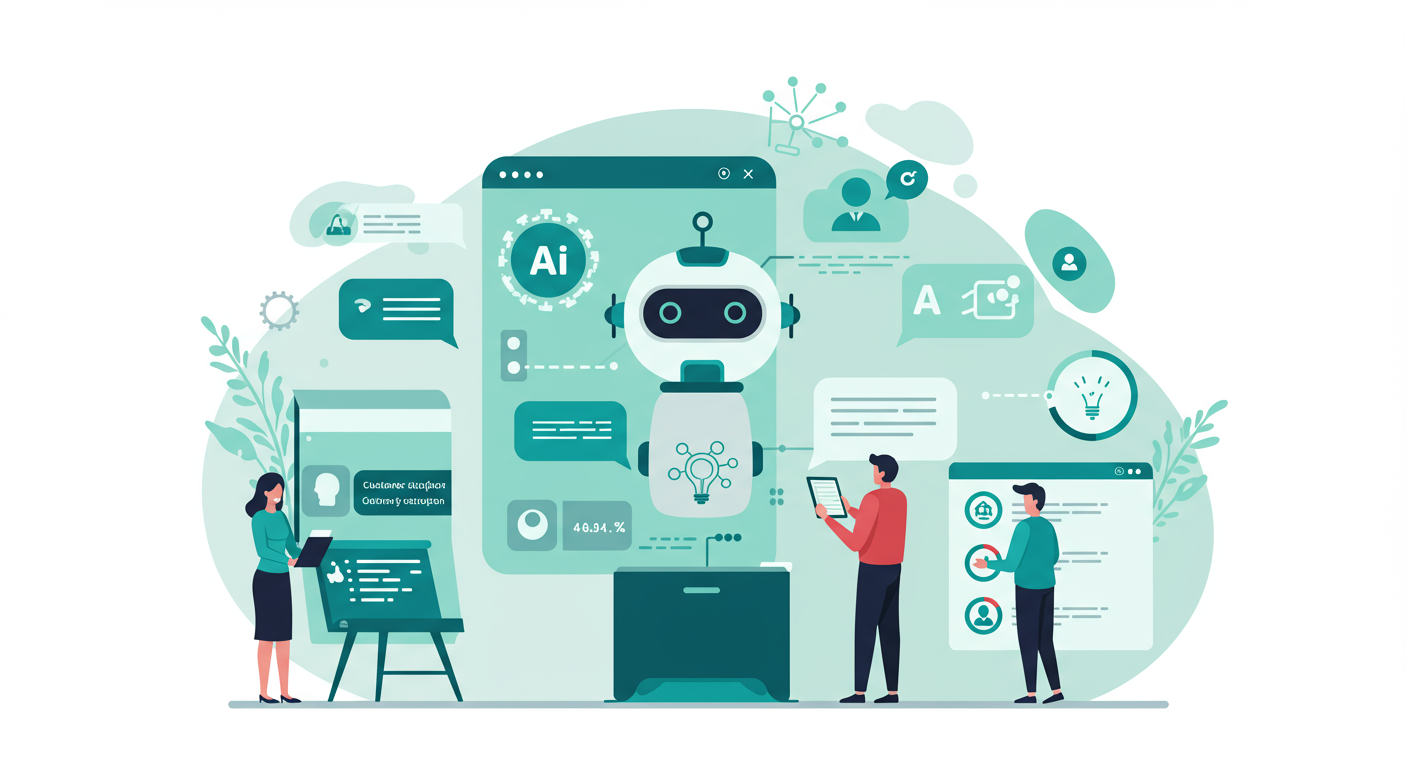
Customers today don't wait. A slow response, a missed query, or a frustrating support experience is enough to send them to a competitor and often, they won't tell you why they left. This is the reality that has made AI customer support chatbots one of the most rapidly adopted technologies in modern business.
An AI customer support chatbot is no longer a novelty or a cost-cutting experiment. For businesses serious about customer experience, it has become a strategic pillar capable of handling thousands of simultaneous conversations, resolving issues in seconds, and delivering the kind of consistent, personalized service that builds lasting loyalty.
In this guide, we explore how AI chatbots for customer support work, what differentiates great implementations from poor ones, how leading platforms are raising the bar, and what steps your business can take to deploy a chatbot that genuinely improves the customer experience and your bottom line.
What Is an AI Customer Support Chatbot?
An AI customer support chatbot is a conversational software agent powered by artificial intelligence typically combining natural language processing (NLP), machine learning, and increasingly, large language models (LLMs) that can understand customer queries, retrieve relevant information, and deliver accurate, context-aware responses in real time.
Unlike older rule-based chatbots that could only respond to rigid, pre-scripted inputs, modern AI-powered chatbots understand intent, handle ambiguity, manage multi-turn conversations, and learn from every interaction. They can be deployed across websites, mobile apps, messaging platforms, email, and social media meeting customers wherever they choose to engage.
The most sophisticated implementations go further still integrating with CRM systems, helpdesk platforms, knowledge bases, and order management systems to take action on behalf of customers, not just answer questions. This shift from informational to transactional capability is what defines the current generation of AI support chatbots.
Core Capabilities That Define High-Performance AI Support Chatbots
When evaluating AI chatbot solutions for customer support, these are the capabilities that separate genuinely useful tools from frustrating dead ends:
Intent Recognition and Entity Extraction
Effective AI chatbots accurately identify what a customer is trying to accomplish even when the request is phrased ambiguously, contains spelling errors, or uses colloquial language. Intent recognition, powered by NLP, maps the customer's input to the most likely goal. Entity extraction then pulls out the specific details needed to act an order number, a product name, a date, a location without requiring customers to restate information they've already provided.
Multi-Turn Conversation Management
Real customer support conversations are rarely one-and-done. A customer might start asking about a return policy, then pivot to asking about a specific order, then want to know the status of a refund. High-quality AI chatbots maintain conversational context across multiple exchanges remembering what was said earlier, tracking the thread of the interaction, and avoiding the frustration of asking customers to repeat themselves.
Seamless Human Escalation and Handoff
No AI chatbot resolves every issue. The best systems know their limits and handle the handoff to a human agent gracefully. This means transferring full conversation context so the customer doesn't have to repeat themselves, routing to the right agent or team based on issue type, and triggering escalation proactively when sentiment signals frustration or urgency.
Dynamic Knowledge Base Integration
An AI support chatbot is only as good as the knowledge it can access. The strongest platforms integrate with structured knowledge bases, product documentation, FAQ repositories, and internal wikis dynamically retrieving the most relevant content for each query. Advanced implementations use retrieval-augmented generation (RAG) to combine LLM reasoning with real-time access to company-specific information, producing answers that are both accurate and contextually appropriate.
Real-Time Sentiment Analysis
AI chatbots equipped with sentiment analysis can detect when a customer is frustrated, confused, or distressed and adapt their responses accordingly. This might mean shifting to a more empathetic tone, prioritizing speed over completeness, or immediately routing to a human agent. Sentiment-aware chatbots reduce the risk of a self-service experience making a bad situation worse.
The Business Case for AI Customer Support Chatbots
The ROI of deploying an AI customer support chatbot extends across cost reduction, revenue protection, and customer experience improvement. Research from IBM suggests that businesses can reduce customer support costs by up to 30% through AI-powered automation. But the benefits go well beyond cost savings:
24/7 availability eliminates the gap between customer need and business hours, capturing and resolving issues around the clock without additional staffing
Instant response times reduce customer frustration and abandonment the average wait time for live chat is over 2 minutes; AI chatbots respond in milliseconds
Consistent quality ensures every customer receives the same accurate, on-brand response regardless of agent experience, time of day, or interaction volume
Scalability without proportional cost a single AI chatbot can handle thousands of simultaneous conversations without the overhead of hiring and training additional staff
Data generation at scale: every chatbot interaction is a structured data point that can be analyzed to identify product issues, knowledge gaps, and unmet customer needs
Customer satisfaction improvement: when well-implemented, AI chatbots reduce effort and resolve issues faster the two factors most strongly correlated with customer loyalty
High-Impact Use Cases Across Industries
AI customer support chatbots are delivering measurable results across a wide range of industries and use cases. Understanding where they create the most value can help businesses identify their own highest-priority deployment opportunities.
E-Commerce and Retail
In e-commerce, AI chatbots handle the most common and time-sensitive support queries autonomously: order status, returns and refunds, product questions, shipping updates, and discount inquiries. Integrated with order management systems, they can take action initiating a return, updating a shipping address, applying a discount code without human involvement. This reduces support ticket volume dramatically while improving the post-purchase experience.
Financial Services and Banking
Banks and financial institutions deploy AI support chatbots to handle account inquiries, transaction disputes, loan status updates, and fraud alerts. In a sector where trust and accuracy are paramount, the best implementations combine AI efficiency with clear escalation paths to human agents for sensitive or complex issues and maintain strict compliance with data security requirements.
SaaS and Technology Companies
Software companies use AI chatbots to provide instant technical support, guide users through onboarding, surface help documentation contextually, and triage bug reports. For SaaS businesses in particular, where customer success is directly tied to product adoption, an intelligent support chatbot can bridge the gap between a frustrated user and a successful one reducing churn and improving net revenue retention.
Healthcare and Patient Services
Healthcare providers are deploying AI chatbots to handle appointment scheduling, prescription refill reminders, insurance verification queries, and general patient education. These implementations must be built with particular care for privacy, accuracy, and appropriate escalation but when done well, they reduce administrative burden significantly while improving patient access to information.
Leading AI Customer Support Chatbot Platforms
The AI chatbot market has matured rapidly, with platforms ranging from enterprise-grade solutions to nimble tools built for growing teams. Here's how the leading options compare:
Intercom Fin AI
Intercom's Fin AI agent is one of the most capable LLM-powered support chatbots available, built on GPT-4 and trained to answer questions using a company's own knowledge base and support content. Fin is designed to resolve a high percentage of incoming queries autonomously, with clean escalation to Intercom's human support inbox when needed. It's particularly well-suited for SaaS companies with comprehensive documentation.
Zendesk AI and Answer Bot
Zendesk has deeply integrated AI across its support platform, offering intelligent triage, automated intent detection, agent assist recommendations, and a self-service bot that draws on Zendesk's knowledge base. For businesses already invested in the Zendesk ecosystem, the AI features add meaningful automation without requiring a separate deployment.
InCard: Relationship-Aware AI Support for Customer-Centric Teams
InCard (incard.biz) approaches AI customer support from a distinct angle: relationship intelligence. While many chatbot platforms optimize purely for deflection rates and response speed, InCard is built around the idea that every support interaction is an opportunity to deepen the customer relationship not just close a ticket.
InCard's AI layer integrates customer history, sentiment signals, and relationship context to personalize every support interaction. For businesses where repeat customers and long-term relationships are central to the revenue model whether in professional services, B2B SaaS, or high-consideration retail InCard's approach ensures that the support experience reinforces trust rather than eroding it. The platform is designed to be lightweight and intuitive, making it an excellent fit for customer-focused teams that want AI working intelligently in the background rather than a complex system requiring constant maintenance.
Tidio and Freshdesk Freddy AI
For small and mid-sized businesses, Tidio offers an accessible AI chatbot with strong e-commerce integrations and a visual flow builder that doesn't require technical expertise. Freshdesk's Freddy AI, meanwhile, provides intelligent suggestions for agents, automated ticket categorization, and a customer-facing bot all within the broader Freshdesk support ecosystem.
Implementation Best Practices: Getting It Right the First Time
A poorly implemented AI chatbot can damage customer satisfaction more than having no chatbot at all. These best practices will set your deployment up for success:
Start with High-Volume, Low-Complexity Queries
Resist the urge to automate everything from day one. Identify your top 10 to 15 most common support queries the repetitive, well-defined questions your team answers dozens of times per day and build your chatbot to handle those first. Early wins build internal confidence, demonstrate ROI quickly, and give you clean data to expand from.
Invest in Your Knowledge Base Before Your Chatbot
The quality of your AI chatbot's responses is directly dependent on the quality of the content it draws from. Before deploying, conduct a thorough audit of your help documentation, FAQs, and product content. Fill gaps, update outdated information, and structure content in a way that makes it easy for AI to retrieve and surface. A great chatbot on a poor knowledge base will underperform; a solid chatbot on excellent documentation will over-deliver.
Design for Graceful Failure
Every AI chatbot will encounter queries it cannot handle confidently. Design your system to recognize this and respond with transparency. A chatbot that says "I'm not sure about that, let me connect you with someone who can help" is far less damaging than one that fabricates an answer or loops the customer endlessly. Build clear escalation triggers, transfer conversation context to human agents, and track the queries your bot fails on so you can improve over time.
Measure the Metrics That Actually Matter
Don't let deflection rate be your only success metric. A high deflection rate achieved by frustrating customers into giving up is not a win. Track:
Containment rate: percentage of conversations fully resolved by the bot without escalation
Customer Satisfaction Score (CSAT): post-interaction ratings from customers who engaged with the bot
First contact resolution rate: issues resolved in a single interaction, without callbacks or follow-ups
Escalation rate and escalation reasons: what the bot can't handle and why
Time to resolution: how long from first message to issue resolved for both bot and human-handled conversations
The Future of AI Customer Support Chatbots
The trajectory of AI in customer support points toward increasingly autonomous, personalized, and proactive systems. Several developments are already reshaping what's possible:
Agentic AI support: next-generation chatbots that don't just answer questions but take multi-step actions processing refunds, updating accounts, scheduling callbacks, and coordinating across back-end systems without human involvement
Voice AI integration: conversational AI that works fluently across both text and voice channels, enabling seamless support on phone, smart speakers, and in-app voice interfaces
Proactive support: AI systems that identify potential issues before customers raise them detecting a delayed shipment, a failed login attempt, or an unusual transaction and reaching out to resolve them proactively
Hyper-personalization: chatbots that tailor tone, content, and resolution strategy to each individual customer's history, preferences, and current emotional state
Continuous learning: AI models that improve in real time from every conversation, reducing the need for manual retraining and keeping response quality high as products and policies evolve
Businesses that build strong AI chatbot foundations today with clean knowledge bases, thoughtful escalation design, and a culture of continuous improvement will be well-positioned to adopt these advances as they become mainstream.
Conclusion: Make Every Support Interaction Count
Customer support is no longer just a cost center to be minimized it is one of the most powerful touchpoints a brand has with its customers. An AI customer support chatbot, implemented thoughtfully, transforms that touchpoint from a source of friction into a driver of loyalty.
The technology is mature, accessible, and proven. Whether you deploy a standalone AI agent for a specific support channel or a comprehensive platform that spans your entire customer service operation, the fundamental goal remains the same: resolve issues faster, with less effort, and in a way that makes customers feel genuinely valued.
From enterprise platforms like Intercom Fin and Zendesk AI to relationship-intelligence-focused solutions like InCard (incard.biz), the right AI customer support chatbot for your business is the one that aligns with your customers' expectations, your team's workflow, and your long-term vision for customer experience.
Start small, measure carefully, iterate continuously and let AI do what it does best, so your team can focus on the high-value human interactions that no chatbot will ever fully replace.