
Premium serviced apartment: whatever language the guest writes in, that is what comes back
Japanese business travellers, Korean families, European specialists, long-stay residents of several months — while the front desk speaks only Vietnamese and English. Every small request had to go through a round of translation. InCard builds an assistant layer that replies in the language the guest used, with one consistent voice across every shift.

Design targets
Four numbers the system is designed to hit.
The first two measure what the system does directly. The third does not: a review score depends on the whole stay — the apartment, the food, how staff behave — so the answering layer is only part of it. We are leaving it here, with exactly this warning attached.
The four figures above are design targets, not measured results. This page describes a solution model built for a serviced apartment serving international guests, not a results report from a named client. When we have measured post-launch figures we are cleared to publish, we will update this page and state the measurement period.
The transformation journey
Drop the translation round, keep the house voice.
Step 1
The challenge
A central property serving both a few nights and a few months. Most guests are foreign nationals, and they do not share a language.
- Guests speak many languages; the desk speaks two. Japanese, Korean, French and German all appear, while staff work in Vietnamese and English.
- Even small things cost a round of translation. Extra towels, a noisy air conditioner, a question about restaurants nearby — every request means typing through a translation tool and guessing whether it landed.
- Everyone writes differently. The same answer comes out curt from one person and over-familiar from another. In this segment, the voice is the product.
- Long-stay guests repeat themselves constantly. Someone renting for three months still explains their preferences again to each new shift.
- Requests arrive from many channels. International booking channels, messaging apps, the website, the phone — each with its own inbox.
- Nowhere for guests to serve themselves. Anything they want means coming down to the desk or making a call.
Step 2
The solution
Three parts: reply in the right language, hold the right voice, and turn requests into work somebody owns.
Replying in the language the guest used
- The assistant recognises the language of the message and replies in that same language. If the guest switches to English mid-conversation, it switches too.
- The initial language set covers Vietnamese, English, Japanese, Korean, French, German and Chinese — chosen to match the property's actual guest mix, not on the principle that more is better.
- This removes the translation round from everyday requests, which is where most of the volume sits.
One voice across every shift
- The voice is written down and loaded into the assistant, rather than left for each person to interpret. For this segment the target sits between the two extremes: not as cold as an announcement, not overly familiar either.
- The single most important rule about voice: the words may only promise what the property actually does. A warm greeting that mentions flowers that are not there is exposed the moment the guest walks into the apartment — and at that point a good voice becomes a mark against you. Every detail in a greeting has to match what housekeeping genuinely prepares.
- The real benefit is consistency: a guest asking at two in the morning gets the same voice as one asking at two in the afternoon.
From a question to work somebody owns
- In-house work — laundry, extra cleaning, restocking drinks, repairs — becomes a ticket routed to the right department, with the unit number and the request written in Vietnamese for staff.
- Outside work — airport transfers, spa, tours — is referred to partners the property has chosen, with booking help.
- Suggestions on request: restaurants matched to each nationality's tastes, how to get around, what is worth seeing. This is what foreign guests ask about most, and what costs staff the most time.
- For long-stay guests the assistant can remember a few recurring preferences so the next request does not start from scratch.
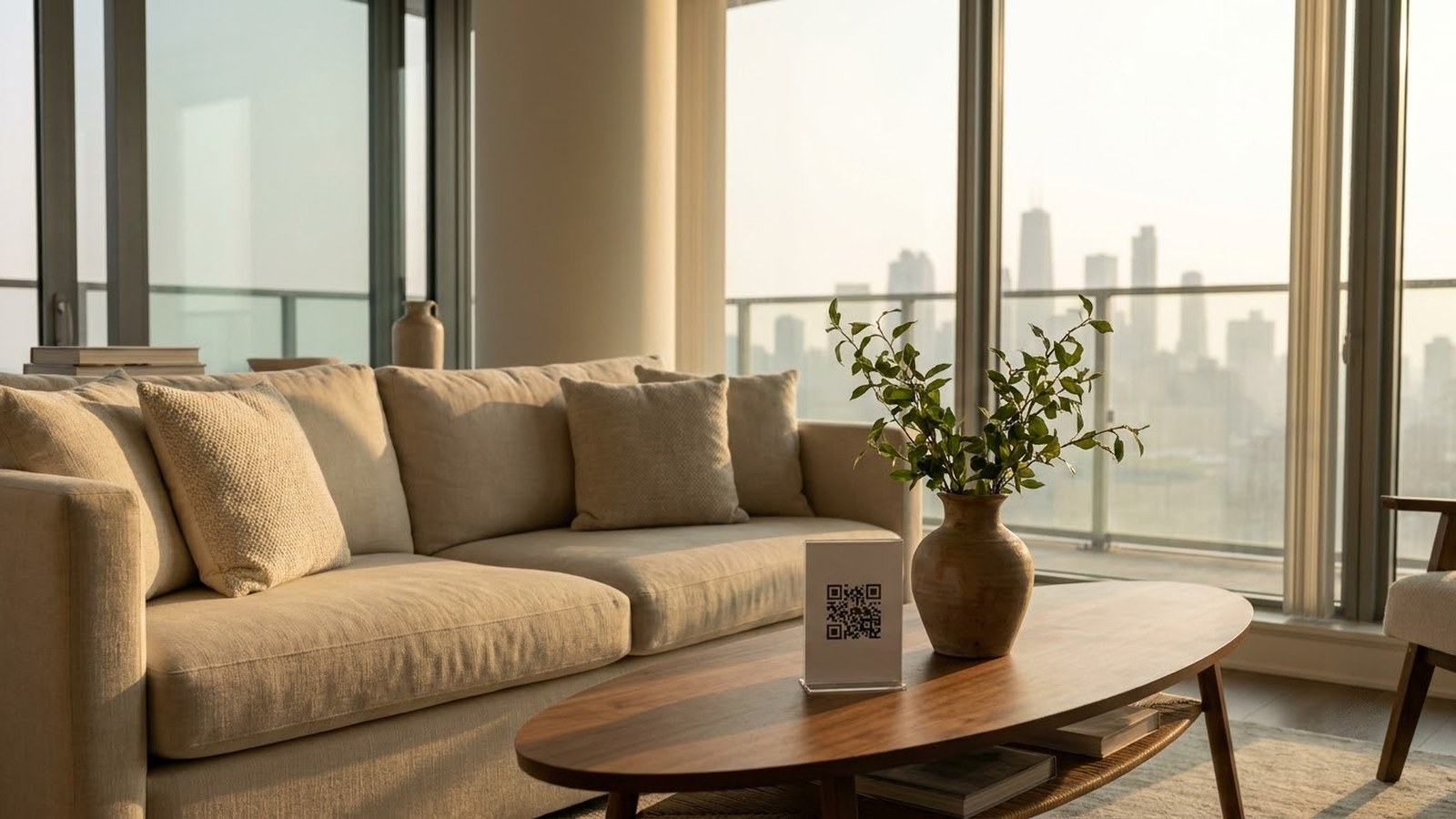
Present where the guest already is
- The QR code in the apartment, the chat window on the website, and the messaging apps the guest used to book — all feeding the same guest record.
Step 3
Boundaries to hold
The premium segment forgives mistakes less readily, so the boundaries here are tighter than in the other models.
- Multilingual does not mean the barrier is gone. Machine translation does well on everyday requests and worst exactly when it matters most: a complaint, a conversation with nuance, or anything touching health, money or the law. Those have to go to a person — and if the property has nobody who speaks that language, you need a real interpreting line.
- Remembering preferences is profiling your guests. Tell them the property keeps this, what it keeps, and let them ask you to stop or delete it. Do not let a guest find out by noticing that the assistant knows too much about them.
- Long stays bring a residence registration duty. For foreign nationals renting for several months, reporting to the authorities remains the property's responsibility. The system prepares the data; it does not file it for you.
- A good voice cannot rescue bad service. If tickets are created and nobody works them, the assistant just helps guests be disappointed more politely. What happens after the ticket matters more than the wording.
- Outside partners have to be chosen by the property. The assistant only refers places that have been approved, because a bad recommendation will be remembered as your mistake.
Step 4
Operating targets
Each target is tied to a mechanism above. These are thresholds set at design time, not measurements taken after go-live.
- Whatever language a guest writes in, somebody answers. Because recognising the language and replying does not depend on who is on shift.
- The same voice across every exchange. Because the voice is written down rather than left to each person's judgement.
- The front desk gets time back. Because the repetitive questions move to the system while looking after the guest in person stays with people — and in this segment, that is the part guests are paying for.
- Long-stay guests stop repeating themselves. Because the record follows the guest rather than the shift.
About the five-star review target: it sits at the end of the chain, not as a direct output of this layer. Fast replies in the right voice stop guests getting annoyed, but what decides the score is still whether the apartment is clean, whether things are broken, and whether requests actually got done. Measure the first two numbers first, then watch whether the review score moves with them.
About this model
A premium serviced apartment
Next step
Are your guests having to write in a second language?
A demo to find out which languages your guest mix actually uses, then pick the language set from that rather than switching everything on.